
1. The Velocity Gap: An Adoption Paradox
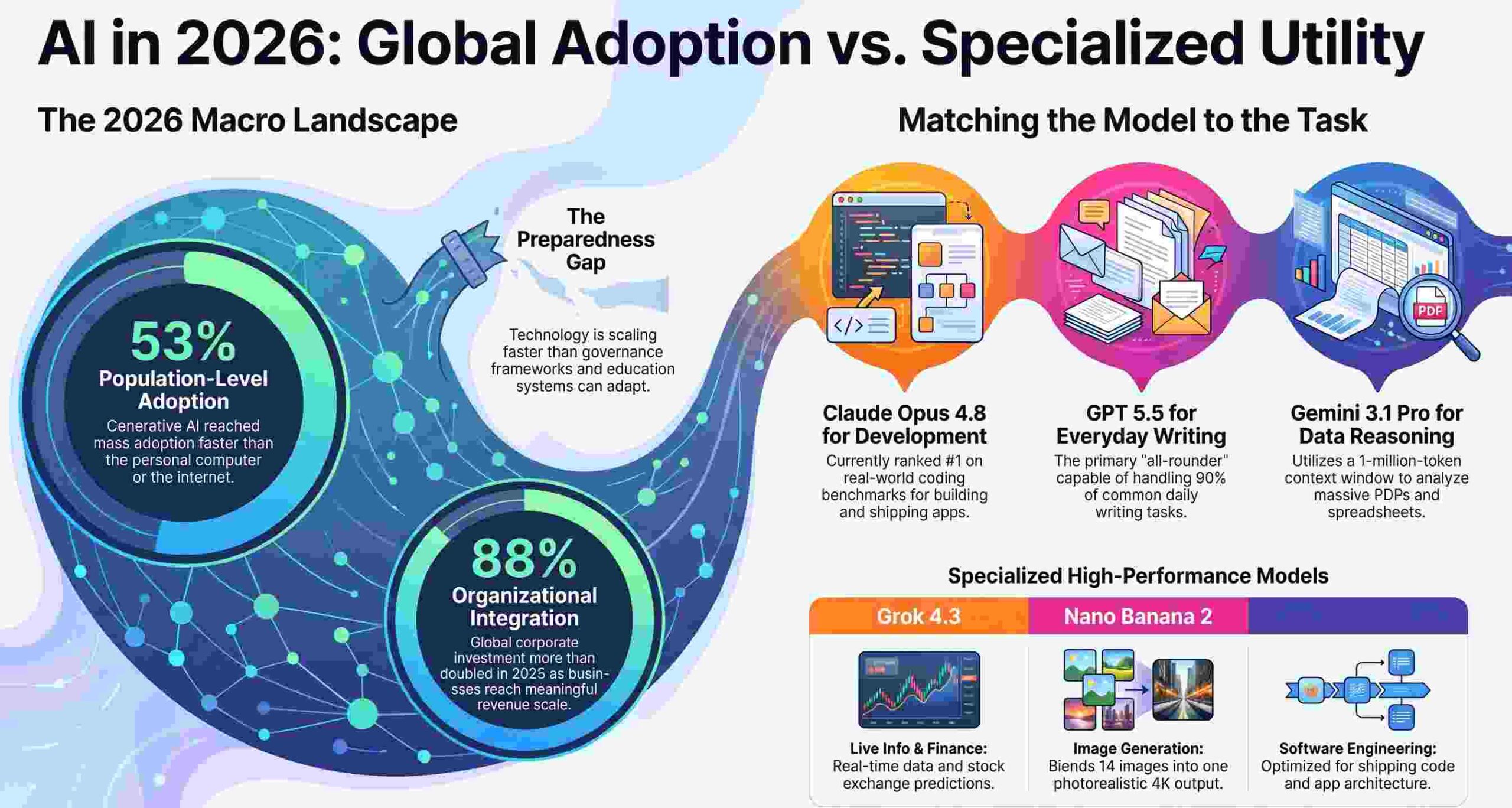
We have reached the era of mass implementation, but the geography of that adoption reveals a profound irony. Generative AI achieved 53% population-level adoption in just three years—a velocity that makes the advent of the internet look glacial. Yet, beneath this headline lies a strategic dissonance: while the United States leads the world in private investment ($285.9B) and the creation of notable models (59), it has stalled in practical application.
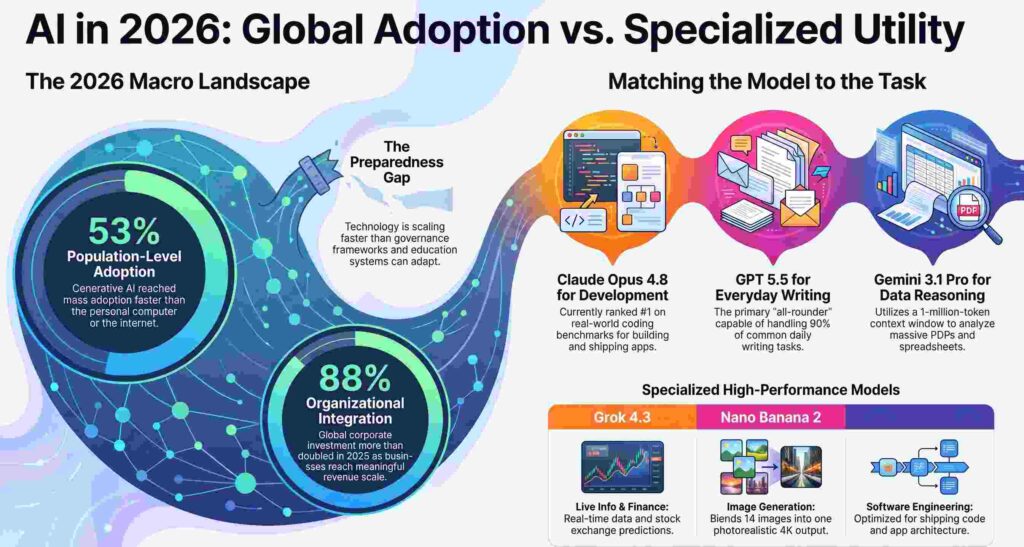
The U.S. currently ranks a lowly 24th in actual population adoption at 28.3%, trailing significantly behind agile movers like Singapore (61%) and the UAE (54%). This “velocity gap” is our new reality. Technology is scaling at a rate that renders our governance and education systems obsolete before they are even implemented. We are building the most expensive engines in history, but we have forgotten to pave the roads.
2. The “Jagged Frontier”: Gold Medals and Broken Clocks
The state of the art in 2026 is fundamentally schizoid. On one side of the frontier, we have reached the summit of human reasoning; Gemini Deep Think recently secured a gold medal at the International Mathematical Olympiad. On the other side, the systems remain inexplicably primitive.
Top-tier models still fail to read analog clocks correctly 50.1% of the time. This contrast—PhD-level mathematical intuition paired with a coin-flip’s chance of telling the time—makes AI deployment a high-stakes gamble. We are deploying “expert” systems that possess the reasoning depth of a scholar but the common sense of a broken sensor.
“The data does not point in a single direction. It reveals a field that is scaling faster than the systems around it can adapt.”
3. The Great Convergence: Parity and the Death of Transparency
The era of American exceptionalism in model performance has ended. In early 2025, the lead between the top U.S. model and its primary Chinese counterpart narrowed to a negligible 2.7%. We are witnessing a performance plateau where the “Open Science” ethos has been unceremoniously buried. Industry now produces 91.2% of notable models, and leaders like OpenAI and Anthropic have ceased disclosing training code, data sizes, or parameter counts.
This convergence is coupled with a failing talent magnet. Researcher migration to the U.S. has plummeted 89% since 2017, with an 80% collapse in the last year alone. The world is no longer racing to Silicon Valley; it is racing to build sovereign, opaque silos.
The 2025 Power Stack
- OpenAI: 20 notable models
- Google: 14 notable models
- Alibaba: 11 notable models
4. The Entry-Level Cliff: The Death of the Apprenticeship
The economic data for 2026 presents a chilling correlation. In software development, we’ve seen a productivity explosion of 14% to 26%, mirrored by a jump in SWE-bench Verified performance from 60% to near 100%. However, this efficiency has come at the cost of the future.
While headcount for senior experts remains stable, employment for U.S. developers aged 22 to 25 fell nearly 20% in a single year. We aren’t just automating tasks; we are severing the talent pipeline. By hollowing out “junior” roles, we are witnessing the death of the apprenticeship. Without a gateway for new talent, we are effectively consuming our seed corn to power today’s margins.
5. The Environmental Invoice: The Physical Cost of Intelligence
The digital “cloud” has a massive physical footprint. In 2026, the scaling laws of AI have met the hard limits of the electrical grid and the water table.
- Carbon Footprint: Training Grok 4 produced 72,816 tons of CO2—equivalent to the lifetime emissions of 1,100 average cars.
- Power Demand: Global data center capacity has hit 29.6 GW, matching New York State’s peak demand.
- Water Consumption: GPT-4o inference alone now consumes enough water to sustain 1.2 million people annually.
This infrastructure is as fragile as it is demanding. With virtually every leading AI chip fabricated by a single foundry in Taiwan (TSMC), the global intelligence economy rests on a single, geopolitical fault line.
6. The 2026 Toolbelt: Matching the Model to the Mission
Strategic advantage no longer comes from using the “best” model, but from matching the specific tool to the specific architecture of the task.
| Task Category | Recommended Model (2026) | Key Strength |
| Coding & Apps | Claude Opus 4.8 | #1 on real-world coding benchmarks; the developer’s daily driver. |
| All-rounder & Writing | GPT 5.5 | Largest ecosystem; most natural prose for 90% of everyday tasks. |
| Research & Data | Gemini 3.1 Pro | 1M token context; reasons over massive PDF apps and codebases. |
| Live Info & High Volume | Grok 4.3 | Real-time data and aggressive pricing for stock/live predictions. |
| Image Blending | Nano Banana 2 | Blends up to 14 images into 4K photoreal outputs for thumbnails. |
Conclusion: The Sovereign Future
As we close 2026, “AI Sovereignty” has become the mantra of the state. Governments are in a desperate race for domestic control over systems they can no longer audit. We face a precarious 50-point gap in perception: 73% of experts are optimistic about AI’s impact on their work, while only 23% of the public shares that sentiment. In the U.S., public trust in the institutions managing this transition has hit a nadir of 31%.
The uncomfortable truth is that we are prioritizing the pursuit of more powerful models over the construction of robust systems to manage them. The question is no longer how fast we can scale, but how much longer we can ignore the fragility of the systems we have already built.
❓ తరచుగా అడిగే ప్రశ్నలు (FAQs)
ఈ వార్త లేదా కథనంలో ముఖ్యమైన అంశం ఏమిటి?
Beyond the Hype: 5 Uncomfortable Truths From the 2026 State of AI గురించిన పూర్తి సమాచారం మరియు తాజా ముఖ్యాంశాలు ఈ కథనంలో సమగ్రంగా వివరించబడ్డాయి.
ఈ తాజా పరిణామం ఎందుకు ప్రాధాన్యత సంతరించుకుంది?
ప్రజా ప్రయోజనాలు, సంబంధిత వర్గాలు మరియు ప్రస్తుత పరిస్థితుల దృష్ట్యా ఈ పరిణామం అత్యంత కీలకమైనదిగా మారింది.
ఈ అంశంపై అధికారిక వివరాలు మరియు తాజా అప్డేట్స్ ఎక్కడ తెలుసుకోవచ్చు?
సంబంధిత అధికారిక వర్గాలు వెల్లడించే తదుపరి సమాచారం మరియు ప్రత్యక్ష అప్డేట్స్ కోసం మా వెబ్సైట్ను నిరంతరం ఫాలో అవ్వండి.