
1. Introduction: The Death of the “Ten Blue Links”
We are witnessing the tectonic restructuring of digital value. For decades, the “Link Economy” operated on a simple, albeit increasingly friction-filled, premise: you typed a keyword, and a search engine provided a list of destinations. Today, that model is collapsing under the weight of “AI Slop”—a deluge of low-quality, synthetic content that has turned traditional search into a chore rather than a utility.
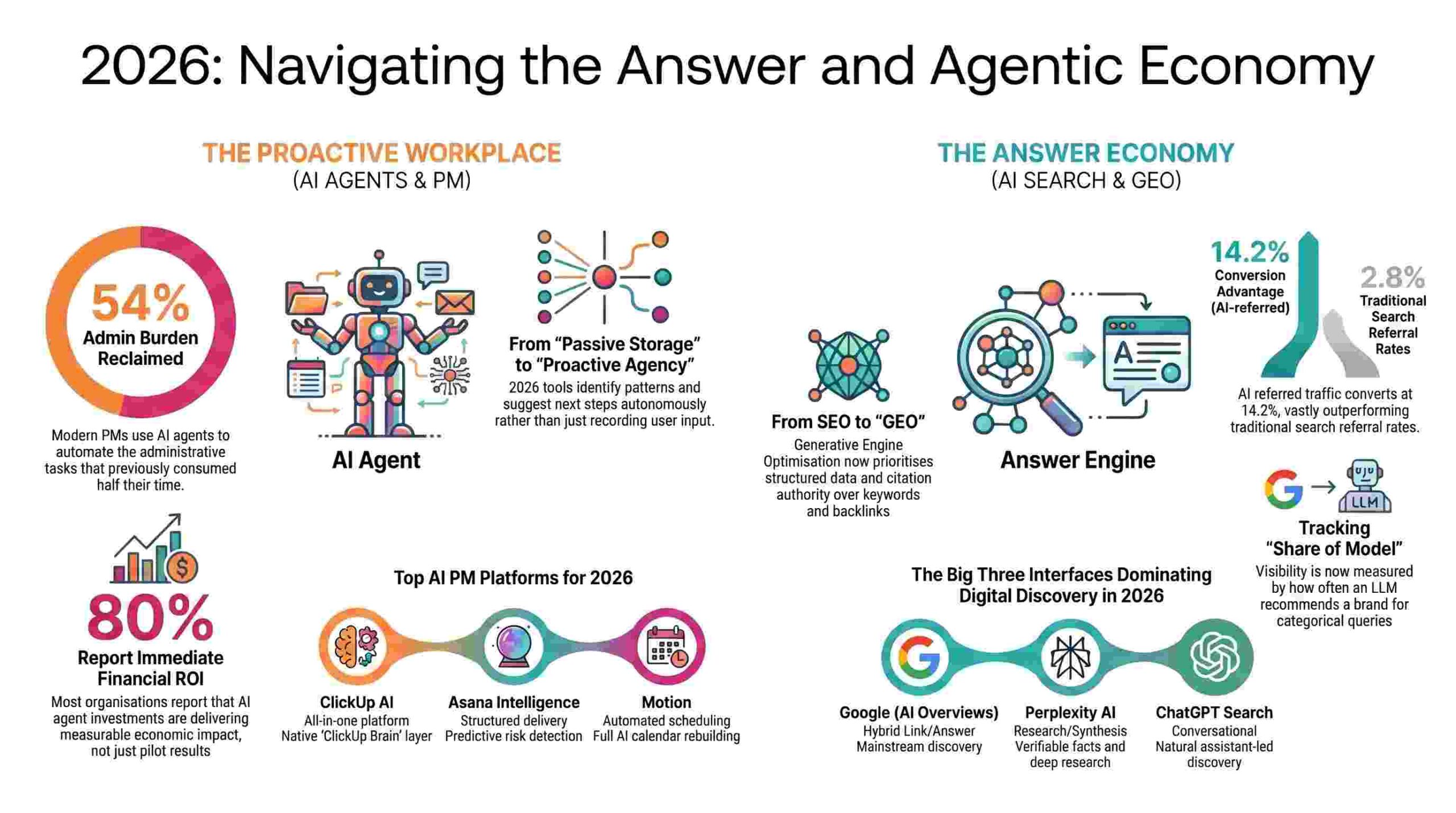
In its place, the Answer Economy has emerged. Users no longer want a list of websites to sift through; they demand immediate, synthesized value delivered directly on the results page. The data confirms this shift is not merely a trend but a structural correction: Google’s search market share has finally slipped below 90% as challengers like Perplexity and ChatGPT Search redefine discovery. In 2026, visibility is no longer about being a link on a page; it is about establishing Citation Authority so that your brand becomes the verified source of truth for the AI engines that now mediate human intent.
2. The Efficiency Paradox: Why 47% Less Traffic is a Win for Business
One of the most jarring shifts for business leaders has been the “HubSpot Effect.” In early 2025, the marketing giant saw its organic traffic plummet from 13.5 million to 8.6 million sessions. While a nearly 50% drop in volume sounds catastrophic, it actually represents a strategic purification of the funnel.
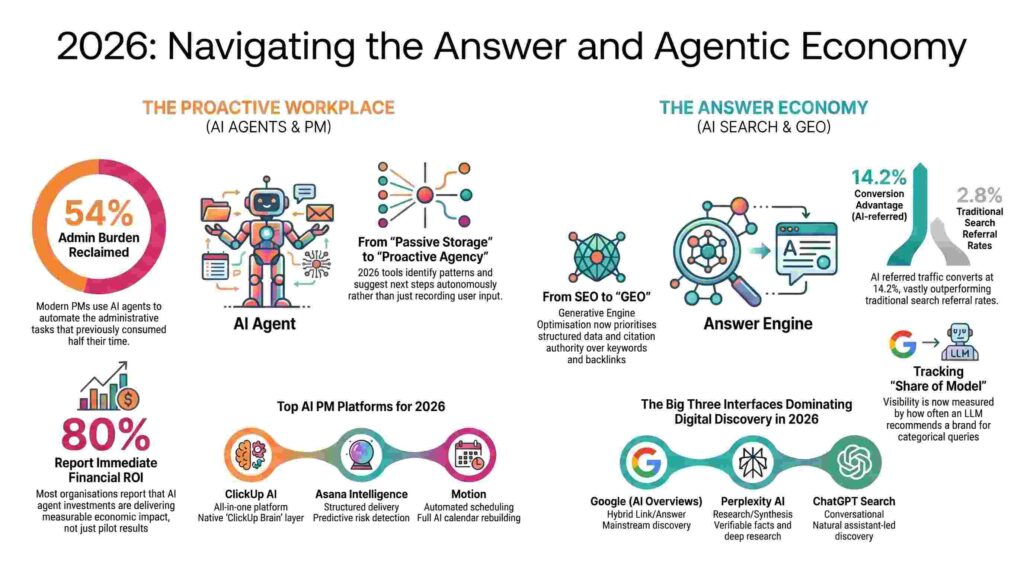
The Shift from Eyeballs to Wallets Informational “vanity traffic”—users looking for quick, free facts—is being absorbed by AI Overviews. This has led to a 47% reduction in organic click-through rates, yet the traffic that remains is “decision-ready.”
- Traditional Search Conversion: 2.8%
- AI-Referred Traffic Conversion: 14.2%
To capture this high-value audience, brands have pivoted from SEO to GEO (Generative Engine Optimization). The goal is no longer just keywords, but ensuring your brand is the “grounding data” for an LLM’s response. As e-commerce expert Ben Salomon notes: “The shift to AI search isn’t just about technology; it’s about trust. Your brand needs to be the answer, not just a link.” This drop in traffic is happening precisely because AI agents are now doing the sifting for us, delivering only the most qualified leads to your doorstep.
3. From Order-Takers to Orchestrators: The Rise of the Multi-Step Agent
The “2026 State of AI Agents Report” reveals that AI has evolved from single-function “pilots” into autonomous orchestrators. We have moved past the era of chatbots; 57% of organizations now deploy agents for multi-stage workflows, with a vanguard of 16% already running cross-functional processes that span multiple departments without human intervention.
The Move to Autonomous Workflow Orchestration This transition is driving a strategic imperative where speed and rigor are no longer a trade-off. The financial stakes are staggering:
- Pharmaceuticals (Novo Nordisk): Transformed clinical documentation from months to minutes. In an industry where a single day of delay costs $15 million in potential revenue, this is a fiscal revolution.
- Cybersecurity (eSentire): Compressed threat analysis from 5 hours down to 7 minutes.
- Retail Analytics (L’Oréal): Achieved 99.9% accuracy in conversational analytics queries, up from 90%, by using an orchestrator model to coordinate specialized sub-agents.
Today, 80% of leaders report these investments are delivering actual, measurable ROI. Agents are no longer waiting for human input; they are reasoning through problems and executing complex mandates.
4. The “Human Moat”: Why Your Opinion is Now More Valuable Than Your Content
We have entered the era of “Model Collapse,” where AI models are increasingly trained on the synthetic “slop” generated by other AIs, leading to a degradation of reality. In this “Trust Vacuum,” the only resource that retains a premium is verified human experience.
Information Gain and the Value of UGC AI engines now prioritize “Information Gain”—net-new, real-world facts that do not exist in their training sets. This has transformed User-Generated Content (UGC) from simple social proof into essential training data for the agentic web.
- The Trust Premium: Shoppers who interact with verified reviews convert at a rate 161% higher than those who do not.
Verified reviews are the primary signal used by AI to establish your brand’s Entity Authority. Your “Human Moat” is built on the documented, un-hallucinated experiences of your customers. In 2026, the unique perspective of a human user is the only data the AI cannot invent, making it the most valuable asset in your marketing stack.
5. The Strategic Evolution: Reclaiming 80% of the Work Day
AI is not replacing the professional; it is liquidating the “admin debt” that has historically consumed 54% of a project manager’s time. Research from HCL GUVI and Gartner indicates a future where 80% of routine PM administration will be automated by 2030.
Automating Routine Execution The impact is most granular in the engineering sector, where agents are freeing up developer time across the entire lifecycle. Productivity gains have hit a remarkable plateau of efficiency:
- Code Generation: 59% time gains.
- Documentation: 59% time gains.
- Testing: 59% time gains.
- Review: 59% time gains.
- Planning & Ideation: 58% time gains.
This shift allows roles to evolve from rote execution toward high-leverage strategy and leadership. AI removes the overhead, but it places a higher premium on human judgment and relationship building. The manager is no longer a task-tracker; they are a strategic architect.
6. The Tool-Kit: A Scannable Guide to the 2026 Ecosystem
To thrive in the Answer Economy, professionals are moving away from fragmented apps and toward a consolidated ecosystem of “Agentic Infrastructure.”
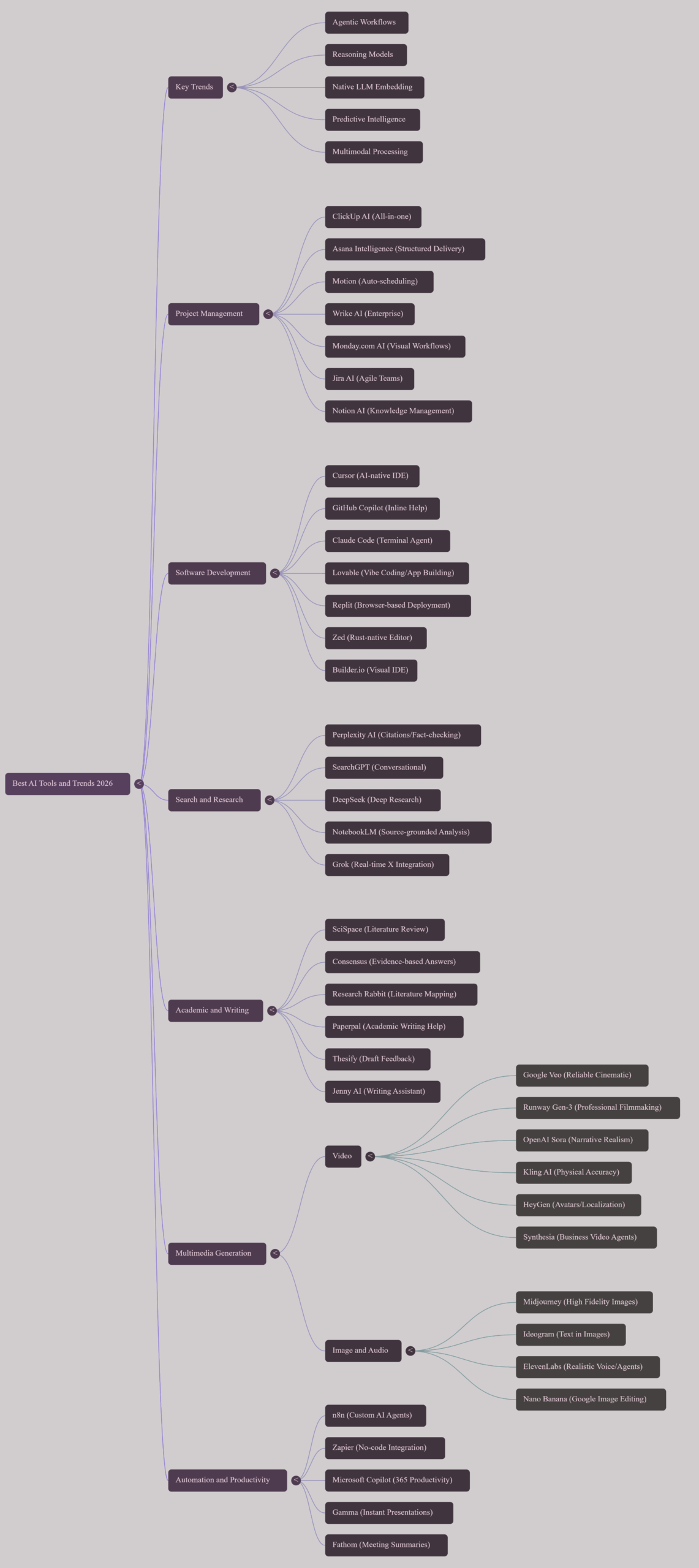
- Perplexity AI: The “Truth Engine.” Strategic Why: Essential for capturing the high-intent referral traffic that converts at 14.2%.
- ClickUp AI: The “Work Brain.” Strategic Why: Natively solves the 54% “admin debt” by automating status updates and task generation.
- Claude: The “Reasoning Standard.” Strategic Why: The gold standard for clean coding and structured technical reasoning with the lowest logic-error rates.
- Lovable: The “Shipping Catalyst.” Strategic Why: Enables non-technical teams to build web apps from prompts, shipping code 20x faster than manual development.
- Fathom: The “Context Keeper.” Strategic Why: A “forever free” notetaker that ensures project knowledge isn’t lost, turning meeting transcripts into automated action items.
7. Conclusion: The Accountability Shift
As we navigate 2026, the primary role of AI is to eliminate the friction of execution. It can generate your plans, write your code, and summarize your research in milliseconds. However, as the burden of “doing” decreases, the weight of “deciding” increases.
AI removes the overhead, but it does not remove the responsibility for the outcome. In an era where execution is a commodity, your value is defined by your strategic choices. As AI takes over the execution of your projects, are you prepared for the weight of the strategic decisions that remain?