
1. Introduction: The Shift Behind the AI Hype
Between 2023 and 2024, the technology industry was swept by indiscriminate AI enthusiasm—a period when simply adding a transformer model to a software interface was enough to capture headlines and venture capital. By 2026, however, the market has undergone a dramatic shift. Underlying web analytics, operational automation logs, and critical mineral supply metrics reveal that the initial era of uncritical experimentation has officially ended. In its place stands a pragmatic, data-verified landscape where utility, security, and physical constraints dictate adoption.
Beneath the surface of corporate promises, user behaviors and engineering requirements have undergone fundamental realignments. From the cracking of early chatbot monopolies and the transition to prompt-driven software architecture, to the surprising physical tethers binding cloud intelligence to mineral extraction, five empirical trends highlight how organizations and professionals are actually deploying AI in 2026.
2. Takeaway 1: The Monolith Is Cracking—Claude’s Surge and the Great Chatbot Realignment
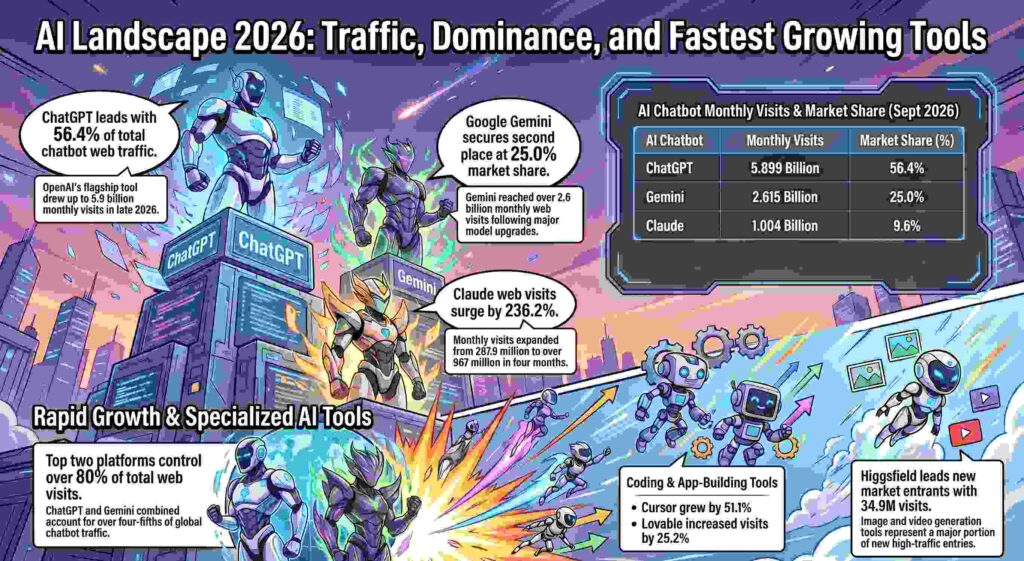
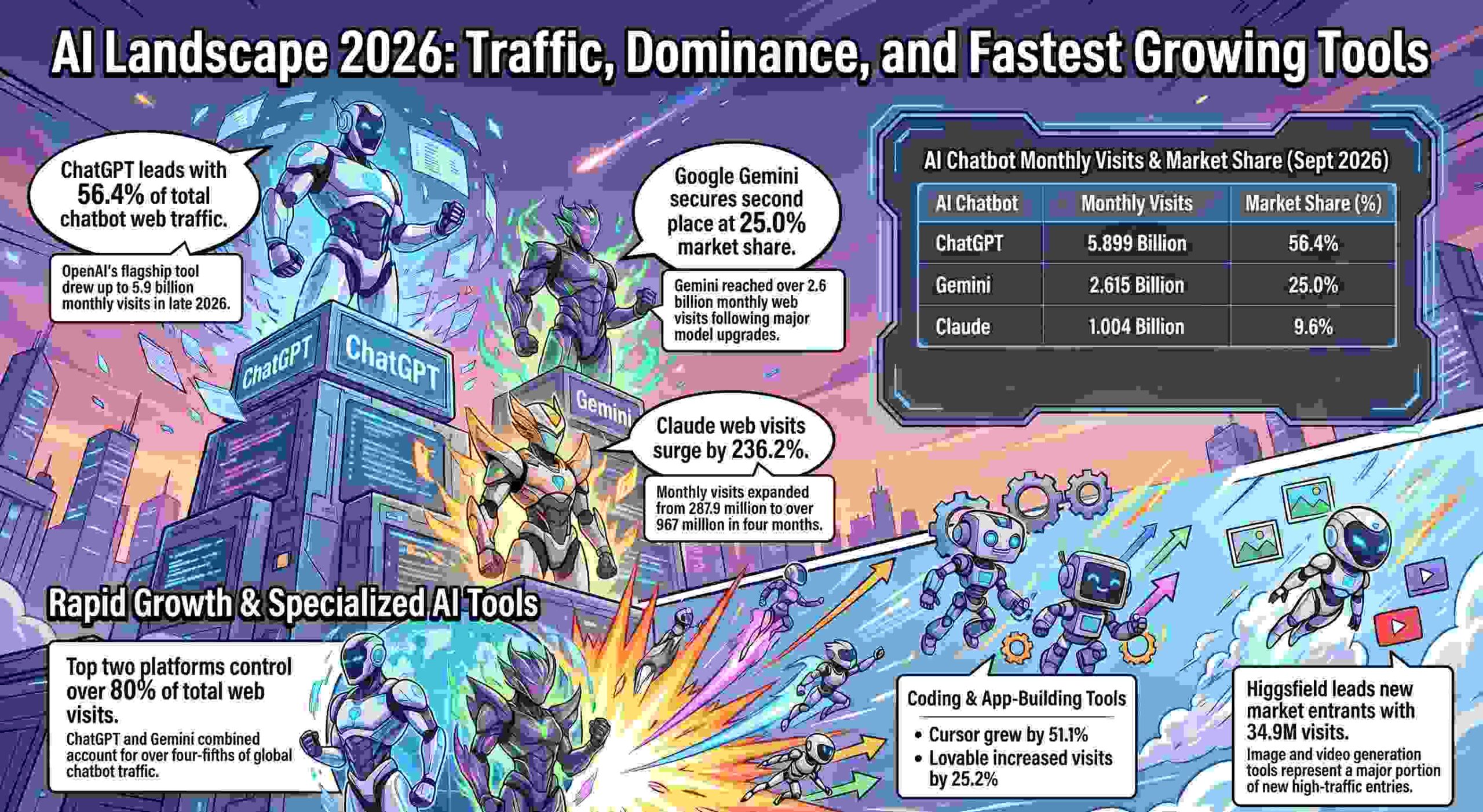
Data from web analytics platforms Similarweb and Exploding Topics highlights a significant realignment across the conversational AI market. While OpenAI’s ChatGPT remains the traffic leader—logging 5.32 billion visits in June 2026 and holding a 56.4% share of chatbot web traffic in September 2026—its growth has stabilized at +2.4% between February and June 2026. Meanwhile, key rivals are capturing market share or suffering major contractions.
Anthropic’s Claude has executed the most dramatic expansion among primary conversational platforms. Claude’s monthly web traffic surged by +236.2% between February and June 2026, crossing nearly 1 billion website visits (967.9 million in June, reaching 1.004 billion by September 2026). Furthermore, search interest for “Claude AI” expanded by 611% over a two-year window. This surge was propelled by specific cultural and strategic catalysts: Anthropic launched a high-profile anti-ad campaign during the Super Bowl—positioning Claude as a clean, ad-free environment just as ChatGPT introduced sponsored placements to free users—and publicly refused to permit Pentagon contracts involving mass surveillance or autonomous weaponry. These moves propelled Claude to #1 on the U.S. App Store.
Concurrently, Google’s Gemini expanded its market share to 25.0% (capturing 2.615 billion monthly visits in September 2026), driven by a +40.6% traffic increase following the rollout of Gemini 3 and 4 models and deep integration across Google’s consumer product suite. Conversely, search-centric engines and specialized bots experienced sharp traffic declines, with Perplexity falling -21.5% (dropping to a 0.9% market share) and xAI’s Grok contracting by -24.5% (holding 2.3% share).
“Claude’s share has more than quadrupled since October 2025, rising from 2.3% to 9.6% and lifting it from fifth to third place.”
| AI Chatbot | Traffic Change (Feb–June 2026) | Market Share (Sept 2026) |
| ChatGPT | +2.4% | 56.4% |
| Gemini | +40.6% | 25.0% |
| Claude | +236.2% | 9.6% |
| Grok | -24.5% | 2.3% |
| Perplexity AI | -21.5% | 0.9% |
3. Takeaway 2: Workflow Automation Evolved from Moving Data to “Agentic Reasoning”
Enterprise workflow automation has evolved beyond traditional “point-A-to-point-B” data transfers—historically defined by linear triggers like legacy Zapier zaps—to agentic AI reasoning platforms such as Gumloop, Claude Cowork, and n8n. Rather than passively piping static JSON payloads across webhooks, modern platforms pair Large Language Models (LLMs) with Retrieval-Augmented Generation (RAG). By supplying models with live, structured context directly from enterprise knowledge bases, RAG drastically curtails hallucinations and allows autonomous agents to evaluate unstructured data before taking action.
To accommodate strict enterprise compliance standards, platforms have introduced dedicated control infrastructure. For example, Gumloop recently secured a $50M Series B round led by Benchmark and deployed hosted Model Context Protocol (MCP) servers alongside Gumstack—a dedicated security and observability layer providing enterprise IT teams with role-based tool controls and execution audit logs. This infrastructure enables non-technical workers across enterprise organizations like Instacart and Webflow to safely deploy autonomous multi-step agents via plain-language instructions.
- YouTube to SEO Blog Agent: Automatically ingests raw video URLs, processes speech transcripts, structures written outlines, and generates fully formatted, SEO-optimized blog articles.
- Social Media Sentiment Agent: Continuously tracks online brand mentions, analyzes feedback sentiment using LLMs, and automatically creates prioritized support tickets or project tasks based on urgency.
- Scrape and Categorize Leads Agent: Scrapes potential client data across target websites, analyzes company profiles, and categorizes leads into CRM pipelines based on candidate quality.
“Gumloop has been critical in helping all teams at Instacart – including those without technical skills – adopt AI and automate their workflows, which has greatly improved our operational efficiency.” — Fidji Simo, CEO @ Instacart
4. Takeaway 3: The “Non-Technical Developer” Is Formally Here
The technical barrier separating software engineers from non-technical business staff has largely eroded, accelerated by AI-native Integrated Development Environments (IDEs) like Cursor (which saw monthly web visits climb 51.1% between February and June 2026), Replit, and Claude Code. Software creation has pivoted from manual, syntax-heavy programming to prompt-based architecture. By articulating functional logic in natural language, non-technical professionals can generate complex multi-file codebases, modify local file structures, and deploy production-ready applications.
This paradigm shift provides non-technical staff with substantial engineering leverage across organizational functions. Senior content writers now build automated performance retrospective workflows that combine web analytics with internal metrics to compile executive reports; non-technical founders deploy custom client-intake platforms connected directly to live backend databases; and senior software engineers utilize agentic coding tools to instantly map unfamiliar codebases and refactor core modules without breaking downstream dependencies.
5. Takeaway 4: Video Production Inverted—You Now Edit Footage by Editing Text
Post-production video workflows have inverted through transcript-based editing software like Descript, Capsule, and Eddie AI. Traditional timeline scrubbing and manual frame trimming are replaced by document-based text manipulation: editors upload raw video, the software generates a synchronized script, and deleting words or sentences directly removes the corresponding video frames from the timeline.
This document-centric editing model is paired with automated rough-cut generation and algorithmic clip extraction. For long-form projects, Eddie AI ingests raw interview footage alongside a creative brief to assemble a 40-minute documentary rough cut in minutes. Simultaneously, platforms like OpusClip analyze long webinars or podcasts, calculate virality scores for individual talking points, and automatically extract, reframe, and caption short clips for rapid social media distribution.
- AI Video Generators: Platforms (e.g., Google Veo, Runway, LTX Studio) focused on rendering original, cinematic video scenes and animations directly from text prompts, style frameworks, or reference images.
- AI Video Editors: Tools (e.g., Descript, Capsule, Eddie AI, OpusClip) designed to accelerate post-production on existing footage using transcript-based cuts, automated rough assemblies, and automated captioning.
- AI Video Suites: Specialized workflow suites (e.g., invideo AI, Vyond, Synthesia) tailored for specific content channels, leveraging stock media assembly, animated character generation, or synthetic digital avatars.
“Descript is a huge time saver that lets you edit your video as easily as you would a Google Doc.”
6. Takeaway 5: The Digital AI Future Is Bound to Fragile Physical Bottlenecks
Despite the intangible nature of cloud-hosted intelligence, the expansion of AI hardware infrastructure is bound to geographic supply chains for critical minerals. World Bank and U.S. Geological Survey data reveal that three foundational materials powering data center processing, storage, and electrical management suffer from extreme geopolitical concentration.
Gallium, essential for Gallium Nitride (GaN) semiconductors operating at high voltages and temperatures in AI data centers, sees 99.0% of its processed global production controlled by China. Rare earth elements—crucial for neodymium magnets in high-capacity hard drives, displays, and optical sensors—are similarly dominated by China, which commands 69.2% of world mine production.
Tantalum, vital for high-capacitance polymer capacitors that stabilize power delivery in AI servers, exhibits even tighter regional concentration. The Democratic Republic of the Congo produces 52.0% of the global mine supply, while neighboring Rwanda (16.0%) and Nigeria (15.6%) bring Central Africa’s aggregate share of world tantalum mine production to 83.6%. Disruptions in these regional bottlenecks directly impact server manufacturing, driving severe market volatility—such as tantalum prices nearly tripling due to surging AI server demand and supply chain friction.
| Critical Mineral | Primary Controlling Country | Share of World Production (%) |
| Gallium | China | 99.0% |
| Rare Earths | China | 69.2% |
| Tantalum | Democratic Republic of the Congo | 52.0% |
7. Conclusion: Navigating the Next Wave of AI Realities
The artificial intelligence landscape in 2026 is defined by pragmatic operational execution rather than unexamined hype. Single-model market dominance has given way to targeted competition as specialized platforms like Claude capture market share; workflow automation has evolved from point-to-point data transfers to secure, RAG-powered agentic reasoning; software development has shifted toward prompt-driven architecture accessible to non-technical staff; media post-production has inverted toward document-based editing; and cloud-based software tools remain fundamentally tied to vulnerable, highly concentrated physical mineral supply chains.
As intelligent agents lower the barrier to building complex software while physical supply chains constrain hardware growth, how will you adapt your organization’s strategy to navigate these technical realities?
❓ తరచుగా అడిగే ప్రశ్నలు (FAQs)
ఈ వార్త లేదా కథనంలో ముఖ్యమైన అంశం ఏమిటి?
Beyond the Hype: 5 Surprising Data Trends Reshaping the AI Landscape in 2026 గురించిన పూర్తి సమాచారం మరియు తాజా ముఖ్యాంశాలు ఈ కథనంలో సమగ్రంగా వివరించబడ్డాయి.
ఈ తాజా పరిణామం ఎందుకు ప్రాధాన్యత సంతరించుకుంది?
ప్రజా ప్రయోజనాలు, సంబంధిత వర్గాలు మరియు ప్రస్తుత పరిస్థితుల దృష్ట్యా ఈ పరిణామం అత్యంత కీలకమైనదిగా మారింది.
ఈ అంశంపై అధికారిక వివరాలు మరియు తాజా అప్డేట్స్ ఎక్కడ తెలుసుకోవచ్చు?
సంబంధిత అధికారిక వర్గాలు వెల్లడించే తదుపరి సమాచారం మరియు ప్రత్యక్ష అప్డేట్స్ కోసం మా వెబ్సైట్ను నిరంతరం ఫాలో అవ్వండి.