
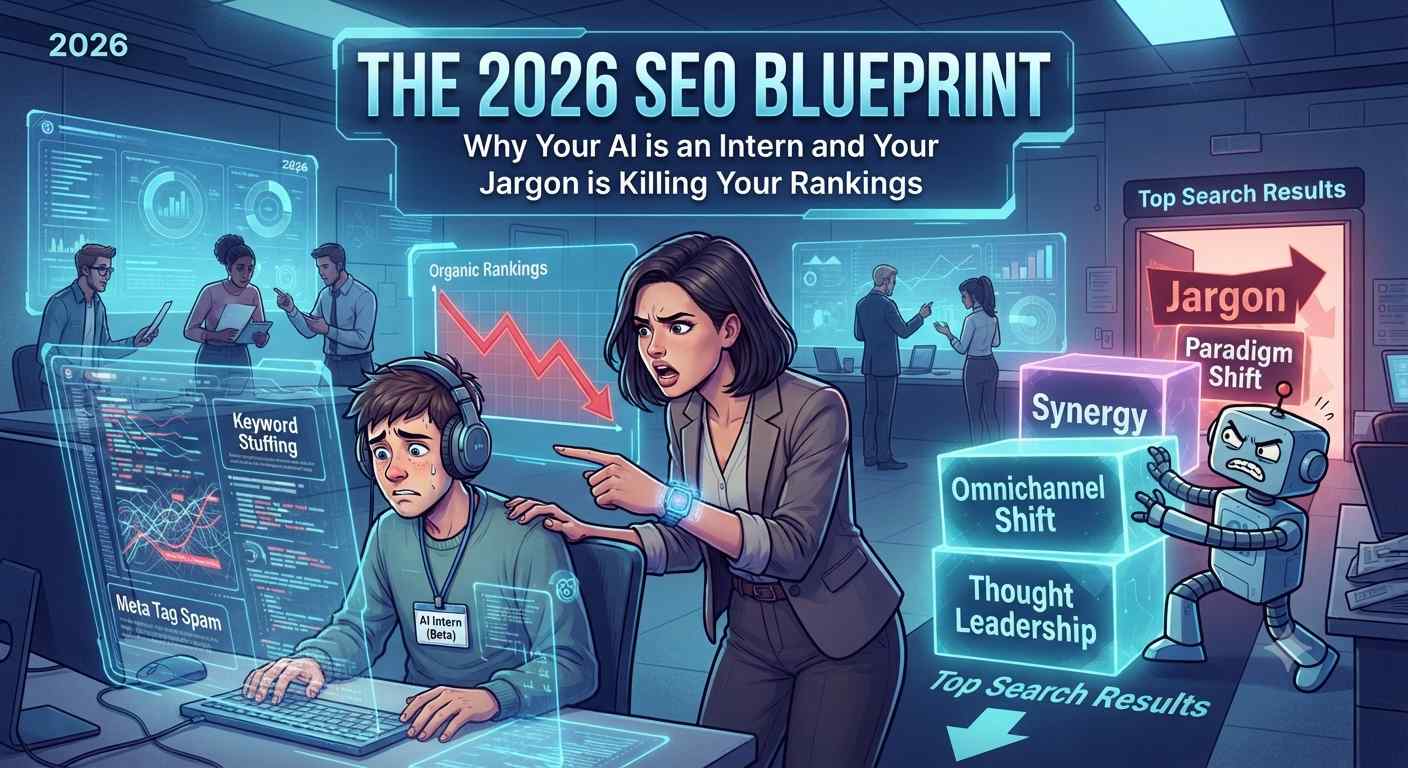
In the current digital landscape, the “noise” is deafening. Modern marketers often find themselves hitting a performance plateau, much like Ritika, a veteran marketing manager who watched her traditional print and billboard tactics lose their edge. Ritika’s revenue stalled because she failed to realize that consumer behavior had shifted toward Instagram-inspired trends, influencer YouTube reviews, and peer recommendations.
The challenge in 2026 is no longer just about being present; it is about surviving an environment where 19% of top search results are already AI-generated. To win, you must move beyond robotic optimization and bridge the gap between technical execution and marketing psychology.
1. AI is Your Intern, Not Your Expert
The new rules of AI SEO are simple: use AI for the “strokes,” but humans must create the “masterpiece.” While AI can accelerate drafting and keyword clustering, relying on it as a primary expert is a high-risk strategy that search engines are increasingly built to detect.
- The Hallucination Gap: Research shows that AI search tools hallucinate or cite incorrect sources 60% of the time. In a YMYL (Your Money or Your Life) world, an unverified fact is a direct hit to your brand’s authority.
- The Hidden Cost of “Free” Content: Many firms believe they are saving money by automating production. However, these “savings” are almost always eaten by the significant costs of fact-checking, sourcing, subject-matter expert (SME) reviews, and tone rewrites.
“AI = intern, not expert. Treat AI as an intern who can get work started – don’t rely on it as you would an expert on your team.” — Stephanie Wallace, SVP of Marketing, Nebo Agency.
2. The “Unsuck It” Revolution: Death to Jargon
Professional lingo is a “hippo-weight” burden on your content. Words like “quintessential” fail to convert because they create irritation rather than engagement. Today’s users—and Google’s algorithms—prioritize “raw” and “unfiltered” styles that prioritize the user’s Search Intent over “fancy” habits.
- Unsuck It: This tool functions as a specialized jargon dictionary, helping you translate over-complicated “corporate-speak” into copy that actually resonates with humans.
- Hemingway Editor: Think of this as the “Shark Tank” judge of your content. While Srishti’s review notes it is often “too strict,” it is invaluable for identifying alternatives for long sentences and complex structures that hinder readability and dwell time.
Simplicity is the ultimate sophistication in SEO. If your copy is too heavy for a “hippo” to handle, your conversion rate will reflect it.
3. The SEO vs. User Experience Conflict
Blindly following SEO tools can be counter-productive. While plugins like Yoast and CoSchedule provide helpful benchmarks, they often suggest “unrealistic” or “robotic” changes. If a tool forces keyword density at the expense of flow, it is failing the user.
- The Missing ‘E’ and Information Gain: To bypass the “AI thumbprint”—generic phrases like “in today’s fast-paced world”—you must prioritize Information Gain. This is the act of providing original insights, data, or firsthand accounts that competitors do not have.
- Experience is King: Adding the “Experience” (the often-missing ‘E’ in E-E-A-T) via case studies and personal perspectives is the only way to prove to Google that your content offers unique value over automated, commoditized text.
4. Seeing Like a Robot: The “Rendered Source” Revelation
Technical visibility is the silent engine of the 2026 blueprint. There is a critical difference between “Raw HTML” and the “JavaScript-Rendered DOM.” If the browser can’t render your “Experience,” the ‘E’ in E-E-A-T remains invisible to search engines.
- View Rendered Source: This essential extension is a game-changer for catching crawl issues. It allows you to see three code sections: the Raw source, the Rendered version, and the Difference. This comparison reveals exactly how JavaScript is modifying your metadata or content before indexing.
- Your Technical Toolkit: To avoid technical blind spots like missing meta descriptions caused by JS execution failures, you need a high-utility extension setup:
- SEOTesting: Pulls Google Search Console data (clicks, impressions, and average position) directly into your browser.
- Keyword Surfer: Overlays search volume and CPC data directly on Google SERPs.
- SimilarWeb: Provides instant competitor traffic estimates and channel breakdowns.
5. Beyond the “Cheap Ad” Myth
Ritika’s epiphany was realizing that digital marketing is a sophisticated “mix of technology and psychology,” not just a cheap replacement for billboards. Digitally mature firms—those that integrate AI, analytics, and strategy—are 23% more profitable than their less-mature competitors.
Success requires a holistic “Sales Funnel” approach that integrates three media types:
- Paid: Targeted advertising (PPC, Social Ads) for immediate attention.
- Owned: Your website, blogs, and infrastructure where you control the brand voice.
- Earned: Customer reviews and peer recommendations that build long-term trust.
“Does it matter that you write a blog post using AI? No. Does it matter that it creates a great user experience and features unique thoughts and ideas? Yes.” — Danny Sullivan, Google.
Conclusion
The era of mass communication is over; we have entered the age of interactive engagement. To win in 2026, you must monitor your Edit Delta—the specific percentage of AI-generated text revised by humans to ensure quality and original thought.
Are you merely publishing what the intern wrote, or are you willing to trade robotic optimization for an authentic human experience? The “Edit Delta” is the difference between hitting a plateau and owning the rankings.
❓ తరచుగా అడిగే ప్రశ్నలు (FAQs)
ఈ వార్త లేదా కథనంలో ముఖ్యమైన అంశం ఏమిటి?
The 2026 SEO Blueprint: Why Your AI is an Intern and Your Jargon is Killing Your Rankings గురించిన పూర్తి సమాచారం మరియు తాజా ముఖ్యాంశాలు ఈ కథనంలో సమగ్రంగా వివరించబడ్డాయి.
ఈ తాజా పరిణామం ఎందుకు ప్రాధాన్యత సంతరించుకుంది?
ప్రజా ప్రయోజనాలు, సంబంధిత వర్గాలు మరియు ప్రస్తుత పరిస్థితుల దృష్ట్యా ఈ పరిణామం అత్యంత కీలకమైనదిగా మారింది.
ఈ అంశంపై అధికారిక వివరాలు మరియు తాజా అప్డేట్స్ ఎక్కడ తెలుసుకోవచ్చు?
సంబంధిత అధికారిక వర్గాలు వెల్లడించే తదుపరి సమాచారం మరియు ప్రత్యక్ష అప్డేట్స్ కోసం మా వెబ్సైట్ను నిరంతరం ఫాలో అవ్వండి.