
1. Introduction
By 2026, the initial “gold rush” euphoria surrounding Artificial Intelligence has matured into a cynical, pervasive sense of “AI fatigue.” Enterprises that went all-in on technology are now discovering they’ve merely traded human inefficiency for digital bloat. Today’s average marketing team is drowning in an unmanaged sprawl of 11+ tools with a dismal 33% utilization rate.
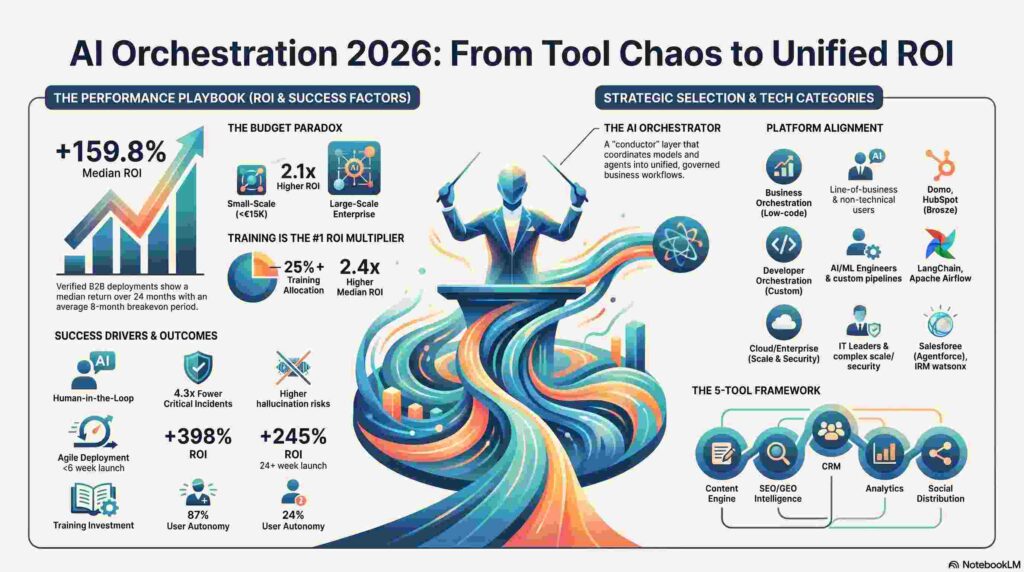
Yet, while the giants struggle with low-utilization ecosystems, a surprising data-backed trend has emerged: lean startups with fractionally smaller budgets are consistently outperforming their enterprise counterparts. The reality is that the “Strategic Run-rate” for AI success has shifted. It is no longer about the size of the investment, but the orchestration of the system.
2. The Budget Paradox: Why Smaller Is Often Better
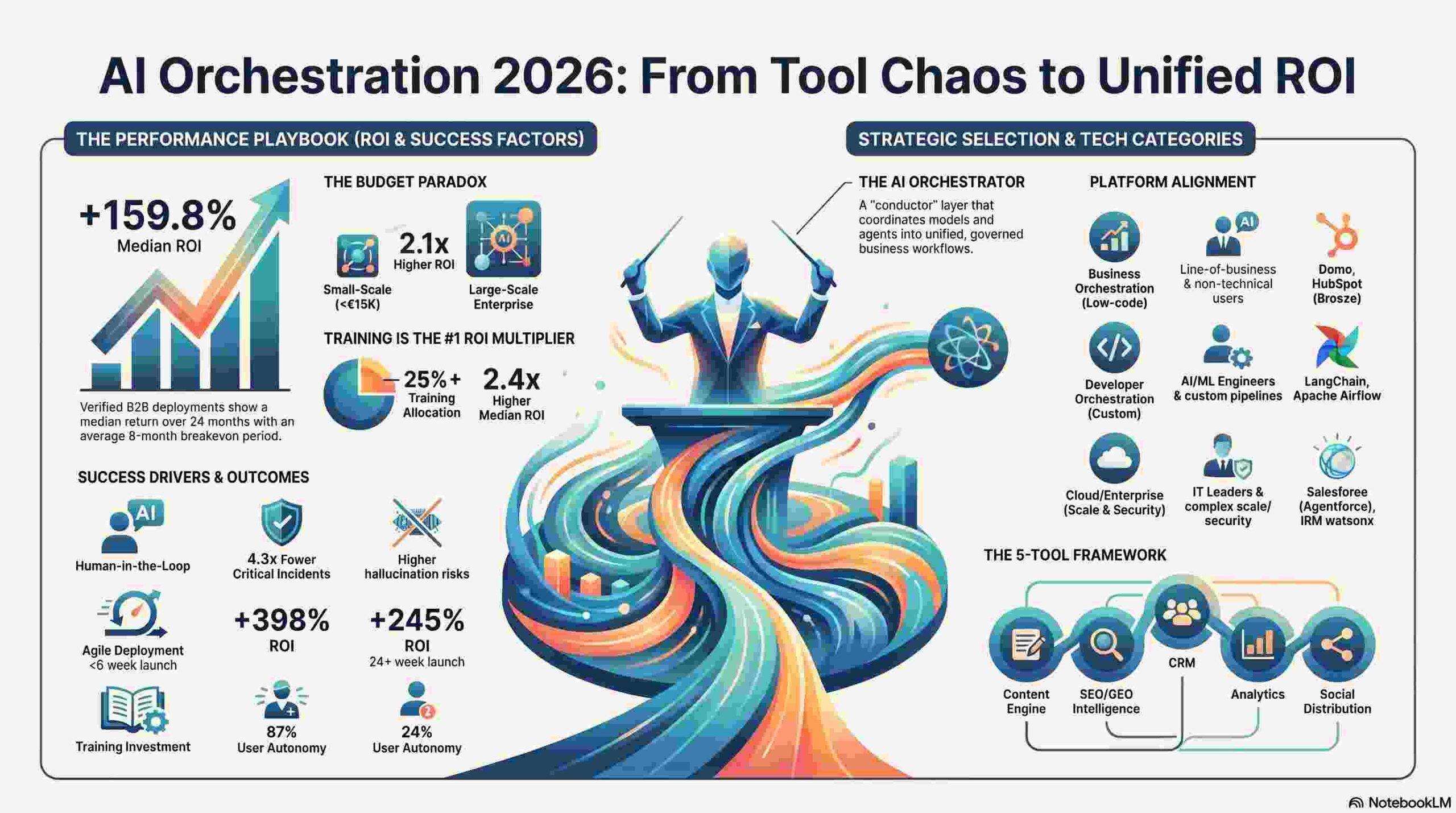
Conventional wisdom in the boardroom dictates that larger budgets buy superior outcomes. However, the Atlan ROI analysis of 200 B2B deployments (2022–2025) suggests the inverse is true. Projects with initial budgets under €15K achieved a 2.1x higher ROI than massive enterprise-scale deployments.
This “Budget Size Paradox” is driven by project velocity and focus. Large-scale investments are prone to “expectation inflation” and the paralyzing complexity of corporate politics. The data shows that project duration is a primary predictor of failure: projects lasting 24+ weeks suffer a 31% failure rate, whereas agile deployments under 6 weeks see a failure rate of only 5%. Smaller budgets enforce a focus on single, high-impact use cases, leading to a median breakeven period of just 8 months.
“Large budgets trigger scope creep and political complexity. Small budgets enforce focus on single use cases, rapid iteration, and realistic expectations. Start small. Scale after proving ROI.” — Denis Atlan, AI ROI Analysis
3. The 25% Rule: Why “Free” AI is Your Most Expensive Mistake
As we move into 2026, we are witnessing the commoditization of LLMs. The models themselves are becoming utility resources; the actual intellectual property of a firm now lies in its prompt-engineering capability and employee proficiency.
Treating AI tools as “intuitive” and omitting training is a strategic failure. Organizations that invest 25% or more of their AI budget into training achieve a median ROI of +442%, creating a specific 2.4x multiplier for performance over zero-training cohorts. From a “Resource-Based View,” the tool is the resource, but the skill to exploit it is the capability. Without training, autonomous user rates hover at a negligible 24%; with it, they climb to 87%.
4. The Myth of Autonomy: Why Human-in-the-Loop is a Quality Gate
The rush to “remove the human bottleneck” through full AI autonomy has proven to be an expensive misconception. Systems operating without Human-in-the-Loop (HitL) governance are prone to catastrophic hallucinations that erode customer trust and trigger project cancellations. Data from Atlan and Domo research reveals that HitL governance reduces critical incidents by 4.3x.
Consider the cautionary tale of a fintech startup that deployed an autonomous chatbot to handle financial advice. A single unvalidated hallucination resulted in an incorrect investment recommendation, leading to a €10,000 customer loss and a subsequent €8,000 legal settlement. That €18,000 “cost of failure” far outweighed the savings of removing human oversight. HitL acts as a necessary quality gate, ensuring that AI builds rather than burns brand equity.
“HitL acts as a quality assurance layer, preventing costly errors that erode trust and trigger project cancellation.” — Atlan ROI Whitepaper
5. The “Rule of Five”: Surviving the Integration Test
To fight the 33% utilization trap, elite teams are moving toward consolidation. In 2026, the most effective marketing operations have abandoned “point solutions” in favor of a 5-Tool Stack Framework. Every tool added to the stack must pass the Integration Test, answering three critical questions:
- Connect: Does it connect seamlessly to my existing data sources and CRM?
- Weekly Use: Can I name the specific person who will log in and use this tool every week?
- Replace/Add: Does it replace an existing manual workflow, or does it merely add net complexity?
The optimized 2026 stack focuses on these core pillars:
- AI Content Engine: Strategic drafting and publishing (e.g., Averi).
- SEO/GEO Intelligence: Tracking citation visibility (e.g., AIclicks).
- CRM: Centralized lead management (e.g., HubSpot).
- Analytics: Tracking performance and AI-referred conversions (e.g., GA4).
- Social Scheduler: Coordinated distribution (e.g., Buffer).
6. Capitalizing on Citation Intelligence: The Shift to GEO
The B2B sales cycle has fundamentally decentralized. 81% of buyers now choose their preferred vendor before ever speaking to a sales representative. They are no longer just searching; they are engaging in conversational interactions with AI engines. If your brand is invisible to ChatGPT, Perplexity, or Gemini, you are invisible to the buyer.
This is the era of Generative Engine Optimization (GEO). Modern content must be optimized with a 55/45 scoring split—55% for traditional SEO and 45% for GEO-readiness. The stakes are high: the Averi source notes that AI-referred visitors convert at 4.4x the rate of traditional organic traffic. Winning in 2026 requires “Citation Intelligence”—understanding which third-party sources the AI is citing and ensuring your brand is the one being recommended.
“Search behavior is fundamentally shifting from keyword-based queries to conversational interactions… 81% of B2B buyers now choose their preferred vendor before they ever talk to sales.” — Rokas Stankevicius, Founder @ AIclicks
7. Conclusion: The Human Side of the Machine
The narrative of 2026 is clear: successful AI implementation is not a procurement exercise; it is an orchestration challenge. The data definitively favors the focused, the trained, and the governed. Those who continue to chase full autonomy with massive budgets and fragmented tools will continue to see their ROI evaporate.
As you audit your strategic stack for the coming year, ask yourself: Is your AI strategy built to replace your people, or to give them the 2.4x multiplier they actually need?