
1. The Hook: The Context-Switching Crisis
By the time you finish this paragraph, you have likely contemplated switching tabs. If you are an average teacher, the EdWeek Research Center suggests you will rotate between digital tools 23 times every single hour during your planning periods. This isn’t just a minor administrative friction; it is a “23-tab tax” that results in a daily productivity loss of 25 to 45 minutes, according to findings from EduGenius. We are currently navigating a context-switching crisis where the mental energy required to export CSVs and sync rosters between twelve different logins is eclipsing the actual work of pedagogical design.
As we evaluate the 2026 EdTech landscape, the visionary shift is no longer about the “magic” of AI generation. It is about a structural move toward tools that respect the “invisible time” of educators.
2. Death to the Dashboard—The Rise of the Unified Workspace
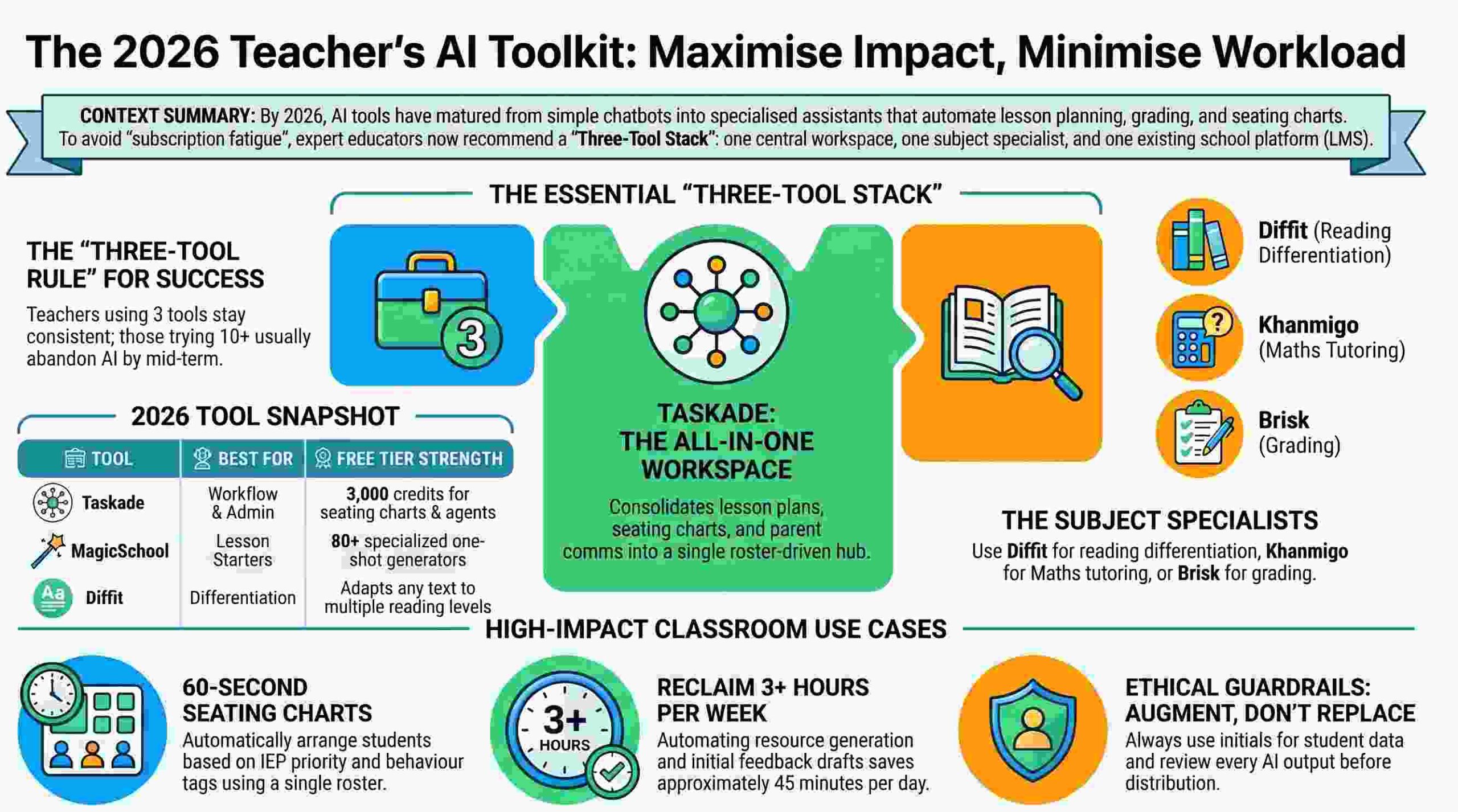
The most significant evolution in teacher productivity is the transition from “one-shot generators” (like MagicSchool or Eduaide) to “unified workspaces” (exemplified by Taskade). While one-shot tools are useful for a quick prompt, they lack “context memory.” They require you to re-introduce your students’ needs and curriculum constraints every time you open a new window.
In a unified workspace, a single class roster drives every output—from seating charts that respect IEP priorities to parent updates. This model succeeds because it acknowledges a fundamental truth: teachers do not need more software; they need a system that mimics their actual mental flow.
“Teachers are the most context-heavy knowledge workers in any sector,” notes recent analysis on workspace design. “A single educator may juggle 150 students, six units, and dozens of IEPs—all of which change weekly. Most tools are designed for the cognitive reality of a software engineer writing a function, but the future of EdTech must align with the teacher’s actual cognitive reality.”
For the practical strategist, Taskade’s workspace model provides a “meaningful month of classroom work” within its 3,000-credit free tier, allowing agents to remember which textbook chapter you are on and which students are currently struggling with specific concepts.
3. Differentiation is No Longer a “Weekend Project”
Manual differentiation—rewriting a single reading passage for three different Lexile levels—has historically been a 45-minute manual slog. Tools like Diffit and Lessonsquill have compressed this into a 3-minute workflow.
Lessonsquill, in particular, showcases the global maturity of these tools by supporting specific national frameworks beyond just the Common Core. Whether you are working with the UK National Curriculum, the IB, or regional standards like NECO (Nigeria), CBSE and ICSE (India), CAPS (South Africa), or NERDC, the AI can now generate curriculum-aligned outputs that are immediately usable.
AI specialists now allow for instant generation of:
- Leveled Texts: Adapting URLs, PDFs, or YouTube transcripts to any grade level while maintaining core meaning.
- Vocabulary Support: Automatically highlighting key terms with definitions matched to the student’s reading level.
- Comprehension Questions: Generating Multiple Choice, Essay, or “Theory-style” questions derived directly from the adapted content.
- Curriculum Mapping: Learning objectives pulled directly from national standards rather than generic AI hallucinations.
4. Socratic Tutoring vs. Answer Vending
As student-facing AI becomes standard, the pedagogical focus has shifted from “answer vending” to Socratic assistance. Standard AI chatbots often provide students with the path of least resistance, but the 2026 stack prioritizes student agency.
Khanmigo stands out here by functioning as a Socratic tutor. It is built with “limitless patience,” a vital relief for an educator managing five classes of 35 students. It refuses to provide direct answers, instead walking students through their own reasoning. This reflects the same “Nordic pedagogical values” found in tools like Curipod—where AI is used to spark curiosity and creativity rather than just delivering information.
“Unlike other AI tools, Khanmigo doesn’t just give answers. It guides learners to find the answer themselves, maintaining safety and learning as a top priority.”
5. The 60-Second Admin (The Seating Chart Test)
The highest value of AI often lies in the “grunt work” rather than high-concept essay writing. The “Smart Seating Chart” has become the industry litmus test for “day-one value.”
Using AI-driven layout generators, a teacher can upload a roster and produce a printable chart in under 60 seconds. The AI handles the complex logic of separating known off-task pairs while prioritizing front-row seating for students with IEP accommodations. These charts can be printed directly for substitute folders, reclaiming the “invisible time” usually lost to manual drag-and-drop interfaces. This automation is the most effective hedge we have against teacher burnout.
6. The “Rule of Three” for Tool Sustainability
Most AI rollouts fail due to “tool bloat.” After interviewing over 200 educators, the most sustainable strategy emerged as the “Standard Stack”—limiting the digital toolbox to three essential categories.
| Tool Category | Role | Example |
| Workspace | The “Source of Truth” for rosters and admin. | Taskade |
| Specialist | Subject-specific deep work (ELA, Math, Science). | Diffit, Khanmigo, or Lessonsquill |
| LMS | Primary delivery vehicle and gradebook. | Google Classroom or MS Teams |
To implement this without overwhelming your schedule, follow this 30-Day Rollout Plan:
- Week 1: Use one tool (Workspace) for one use case: the Seating Chart.
- Week 2: Use the same workspace for your Attendance Tracker and a single Unit Plan.
- Week 3: Introduce one Specialist (e.g., Diffit) to generate differentiated worksheets for a single lesson.
- Week 4: Build a reusable AI Agent in your workspace to handle repetitive tasks like parent email drafting or rubric generation.
7. Ethics & The “Edit Delta”
The non-negotiable mantra for 2026 is “Augment, Don’t Replace.” Professional judgment remains the ultimate filter. As a strategist, I recommend measuring a tool’s value by the “Ratio of Editing”—what I call the Edit Delta. If you find yourself rewriting 80% of an AI’s output, the tool is a liability, not an asset.
Furthermore, we must move away from unreliable AI detectors that frequently produce false positives for English Additional Language (EAL) and neurodivergent students. Instead, we must assess “process, not just product.” Using frameworks like the “AI Diamond 9” to rank classroom uses helps departments establish clear boundaries. The goal is to use AI to draft, but to use the human teacher to authorize.
8. Conclusion: A Forward-Looking Summary
In 2026, we have moved past the era of “AI as a gimmick” and into “AI as infrastructure.” These tools are finally maturing into a workspace that respects a teacher’s cognitive reality rather than adding to it. As you look at your own workflow, ask yourself: If you could reclaim the five hours a week currently lost to the “23-tab tax,” how would you reinvest that time into your students? The machine is here to handle the grunt work; you are here to handle the teaching.