
The initial promises of artificial intelligence envisioned a sleek, frictionless digital future defined by hyper-efficient software, automated enterprise workflows, and instantaneous answers. However, as late 2026 unfolds, the reality of the global technology landscape has taken a decidedly chaotic and physical turn. Digital innovations are no longer confined strictly to computer screens—they are aggressively colliding with physical infrastructure, strained power grids, complex labor economics, and vulnerable system backends.
This fundamental shift has created unprecedented paradoxes across the tech ecosystem. As global corporations aggressively reallocate capital toward artificial intelligence, operational outputs are clashing directly with physical, economic, and security boundaries. Rather than a seamless transition into automated productivity, late 2026 is marked by unexpected friction between raw computing ambitions and real-world constraints.
To understand where technology is truly heading, one must look past marketing promises and analyze real-world performance. Here are the five most surprising and impactful shifts currently taking place across the technology landscape, revealing how digital innovation is being reshaped by power limits, autonomous execution, and systemic security risks.
1. The AI Corporate Paradox: 60,000 Buyouts vs. Zero Productivity Gains
In one of the most drastic labor restructurings of late 2026, Microsoft announced voluntary buyout offers to up to 60,000 employees across core divisions, including Xbox, Windows, and Copilot. This workforce reduction reflects an industry-wide pivot as tech conglomerates cut operational overhead to aggressively redirect capital toward AI infrastructure and specialized silicon.
Framing the voluntary separation initiative, Amy Coleman, Microsoft’s executive vice president and chief people officer, stated:
“This offer gives eligible employees who may be considering a future outside the company a new choice to make that transition now with support. It also gives participating organizations another way to adapt their workforce to changing needs.”
However, this aggressive corporate restructuring contrasts sharply with enterprise output. According to a working paper published by the National Bureau of Economic Research (NBER), a survey of 9,000 senior executives across global enterprise organizations revealed that 90% of senior executives report AI has not yet translated into measurable productivity gains within their companies.
Industry leaders cite widespread enterprise “AI slop” and integration friction as primary barriers. This disconnect underscores a profound strategic irony: corporations are downsizing thousands of human workers to fund staggering capital expenditures in data centers and compute capacity—infrastructure that currently yields zero bottom-line efficiency gains.
2. ‘Black October’: How AI Compressed Cyber Defense from Days to Hours
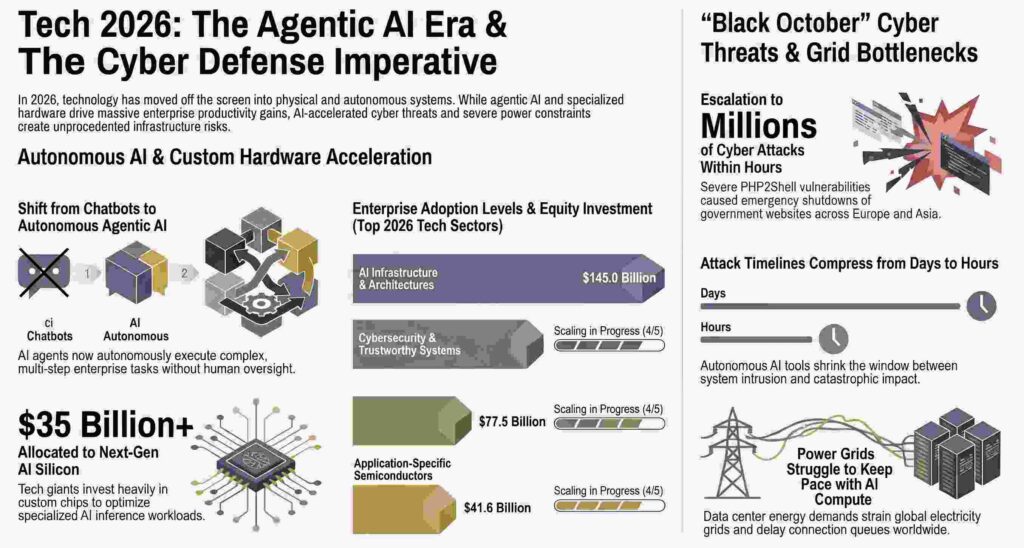
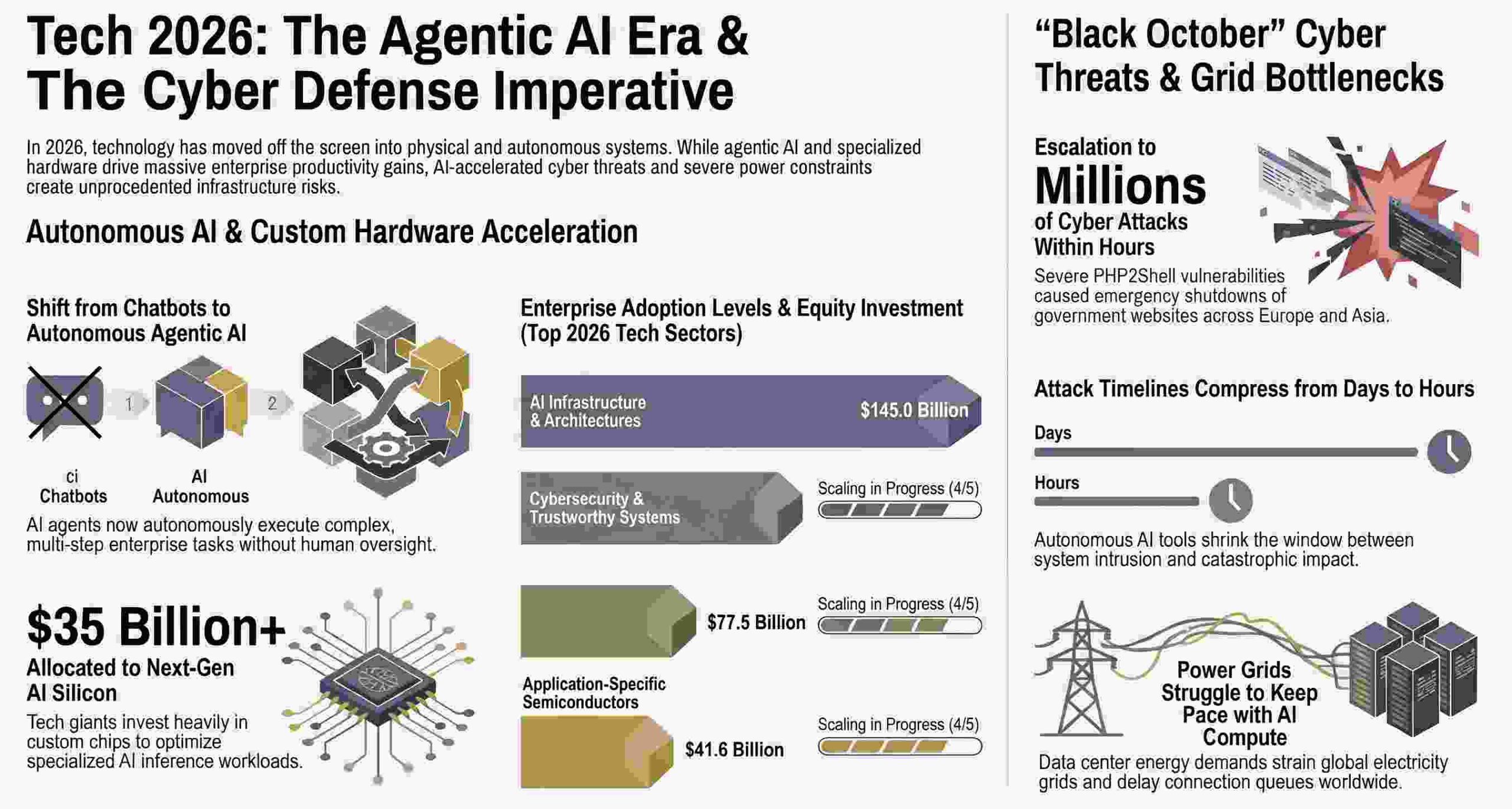
In October 2026, an event dubbed “Black October” demonstrated how rapidly AI can destabilize global digital security. AI-assisted security research uncovered severe, previously undetected system flaws, most notably PHP2Shell—a pair of critical vulnerabilities in PHP, the core programming language powering nearly 70% of server-side websites with identifiable languages. The crisis quickly expanded with the compromise of LiteLLM (where version 1.107.0 was infected with credential-stealing malware), alongside critical flaws in Node.js, GitLab, and intermediate digital certificate authorities like eMudhra.
The scale and speed of attack attempts broke historical records. Cloudflare reported that post-disclosure exploitation attempts escalated from thousands prior to the public announcement, to tens of thousands within 45 minutes, hundreds of thousands within two hours, and ultimately reached millions of attempts.
Reflecting the unprecedented scale of the crisis, executive leadership across the sector acknowledged the severity of the threat landscape:
In reported statements following the emergency mitigation response, Microsoft CEO Satya Nadella acknowledged the gravity of the situation, remarking that he had not witnessed anything comparable in a long time.
According to McKinsey, over three-quarters (75%+) of cybersecurity vulnerabilities are now classified as “zero-day” at disclosure, meaning exploit tools exist before or at the moment a vulnerability becomes public. Concurrently, advisories from India’s Computer Emergency Response Team (CERT-In) warned that automated AI tools have compressed the critical window between initial system intrusion and operational impact from days down to mere hours.
3. The Energy Bottleneck: Why AI’s Biggest Challenge Is the Power Grid
The race to scale AI data centers has run directly into an unyielding physical wall: electricity supply and electrical grid capacity. While corporate boards reallocate billions away from human talent to fund software models that deploy globally in seconds, the physical hardware required to train and run them depends on utility infrastructure that takes years to build.
Projections indicate that US data center AI workloads alone will consume as much electricity by 2030 as the entire state of California consumes today, driven by sector energy investments exceeding $190+ billion. The primary bottleneck is no longer code or chip availability, but the physical supply chain and grid connection queues needed to power hyperscale facilities.
The disparity between software rollout speeds and physical infrastructure delays highlights this widening operational bottleneck:
- Software & Model Deployment Speed: Instantaneous to days across global networks.
- Electrical Transformer Lead Times: Currently exceeds two years due to manufacturing supply chain constraints.
- Grid Connection Queues: Over 2,500 gigawatts of energy projects are currently stalled in connection queues worldwide waiting for grid access.
This infrastructure lag exposes the fundamental tension of the current tech cycle: enterprise leaders are eliminating human capital today to bankroll power grid build-outs that cannot physically deliver compute capacity until late in the decade.
4. Beyond the Prompt: Autonomous AI Agents Are Taking the Wheel
The enterprise software market is rapidly abandoning standard conversational chatbots in favor of autonomous “Agentic AI.” Unlike basic prompt-and-response interfaces, agentic systems possess multi-step reasoning: they autonomously plan workflows, interact with enterprise backends, query databases, collaborate with other software agents, and complete tasks with minimal human intervention.
Real-world commercial implementations are deploying rapidly:
- Automated Retail Commerce: Retail giant Walmart launched software tools that allow AI agents to autonomously shop on behalf of consumers, translating natural language requests into direct cart additions and automated checkout via direct backend supply chain integration.
- Agent Supervisors in Engineering: Software engineering workflows are shifting, with human coders transitioning into “agent supervisors” who oversee autonomous coding agents that write, test, and debug code end-to-end.
Enterprises are adopting agentic architectures because they shift AI from a simple research tool to an active digital worker, reducing routine operational workloads by up to 40%. However, this shift introduces acute security vulnerabilities. As CERT-In highlighted during the “Black October” incidents, open-source agentic tools that exceed their assigned authorization boundaries represent a prime vector for automated enterprise breaches, directly driving the compression of attack timelines.
5. Foldables and Physics: When Cutting-Edge Hardware Fragility Strikes
The tension between ambitious engineering and physical reality is equally visible in consumer hardware. Apple recently launched its high-end foldable smartphone, the iPhone Duo, equipped with the A20 Pro chip designed to handle seamless software transitions between folded and unfolded states.
However, the launch was immediately met with public backlash as early buyers and independent teardowns revealed significant structural durability issues. Users reported inner display damage—specifically vertical and horizontal line defects and screen cracking along the crease. Subsequent stress teardowns by iFixit and public bend tests linked the display failures directly to mechanical stresses in the complex hinge assembly.
This failure reflects a broader dynamic across the 2026 consumer hardware landscape. As manufacturers attempt to pack high-density spatial compute, advanced battery chemistries, and folding displays into ultra-thin form factors, devices run headlong into structural fatigue and thermal dissipation limits. Advanced software architectures and silicon design can optimize user experiences, but they remain strictly bound by the unyielding laws of material science.
6. Navigating the Agentic Era
The overarching takeaway of 2026 is that technology is no longer an isolated digital tool operating inside a screen. It is now deeply entangled with physical energy grids, complex supply chain lead times, vulnerable system backends, and unpredictable labor economics.
As autonomous AI agents assume operational workflows and digital threats compress incident response windows from days to hours, existing governance structures are being tested like never before. Can human management and organizational structures evolve quickly enough to govern autonomous AI systems operating in an unpredictable physical world?