

The “Sticker Shock” Reversal
For the better part of a decade, the iPhone has been the ultimate symbol of “sticker shock”—a luxury item often joked about as requiring a major organ donation to afford. However, as we close out March 2026, I am observing a fundamental shift in the Indian market that every tech consumer needs to track. Data from major retail hubs like Flipkart and JioMart indicates that the “kidney-priced” era is officially over.
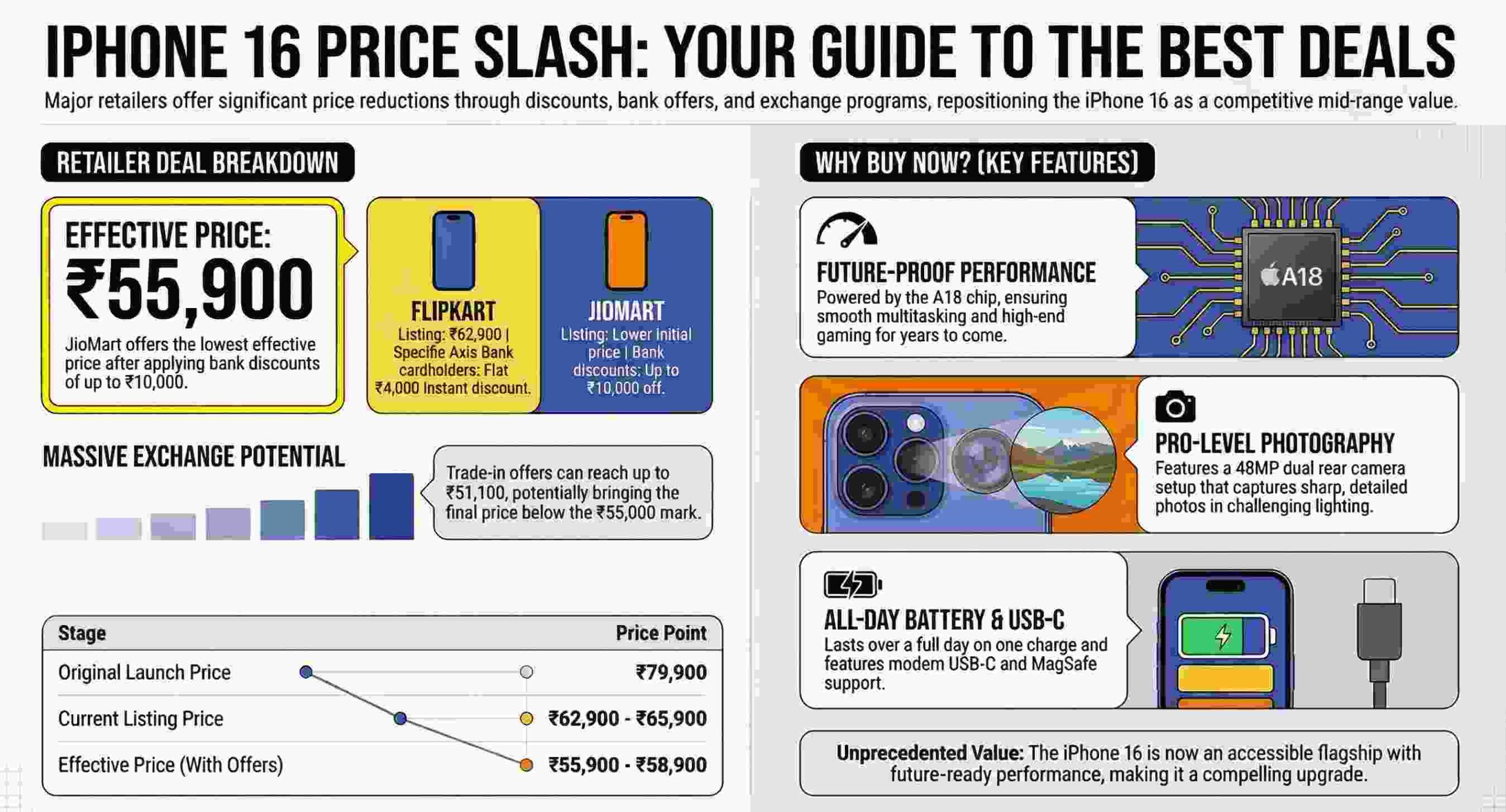
Apple has executed an unprecedented price reset on the iPhone 16 and, more shockingly, the brand-new iPhone 17. By aggressively slashing entry barriers, the “effective price” of flagship iOS hardware has finally converged with the mid-range budget segment. As a market analyst, I view this not just as a sale, but as a deliberate repositioning of the iPhone from an aspirational trophy to a mass-market default.
The Sub-₹55,000 Milestone for Flagship Power
The most critical data point for consumers this month is the breach of the ₹55,000 threshold. However, you must look closely at the fine print to understand where the value truly lies. The iPhone 17 has seen a direct strategic retail cut, now starting at an aggressive ₹54,999. In contrast, the iPhone 16 hits the sub-₹55,000 milestone only after you factor in exchange incentives.
This specific price point is the “psychological tipping point” I have long predicted. It places flagship Apple silicon within striking distance of those who previously settled for mid-range Android devices due to cost.
“Thinking of switching to an iPhone but not at the cost of a kidney? Well, you can consider the one-generation-old iPhone 16, which is now available at a surprisingly good price.” — Divya Bhati, Tech Journalist.
The “Stacking” Strategy: Navigating the Math
To get these deals, I recommend consumers move away from “Listing Price” thinking and master “Effective Pricing.” While the iPhone 16 launched at ₹79,900, the actual cost of ownership has plummeted through a stacking strategy of platform discounts, bank incentives, and trade-ins.
The Math Breakdown (iPhone 16 Example):
- Launch Price: ₹79,900
- Current Listing Price (Flipkart/JioMart): ₹62,900 – ₹65,900
- The “Advocate’s Edge” (Bank & Platform Savings):
- Axis Bank: ₹3,245 to ₹4,000 Instant Discount (Immediate savings at checkout).
- SBI Credit Cards: Up to ₹3,245 Cashback (Note: This usually takes 90 days to hit your account).
- HDFC Bank: ₹1,250 Discount.
- JioMart Bonus: Platform-specific bank offers up to ₹10,000.
- The Exchange Factor: Trade-in values can reach ₹51,100.
Advocate’s Warning: While the effective price can drop below ₹55,000, remember that the highest trade-in values are reserved for recent, pristine-condition flagships. Most consumers should expect a more moderate exchange credit, but when combined with a ₹4,000 instant discount, the value remains unbeatable.
The A18 Chip: Built for the Long Haul
Why is Apple doing this? My analysis suggests they are moving the masses onto the A18 silicon as quickly as possible. This isn’t a “budget” compromise; it’s a high-performance play for longevity. The A18 chip ensures these devices remain “capable even today” and well into the next three to five years of software updates.
Core Hardware Highlights:
- A18 Chip: Optimized for heavy multitasking and sustained performance in demanding titles like COD Mobile.
- 48MP Main Sensor: A dual-camera system that maintains Apple’s lead in shutter consistency and low-light detail.
- 6.1-inch OLED Display: Punchy colors and high brightness that outclass almost everything in the mid-range segment.
- Modern Standards: Full support for USB-C and MagSafe, ensuring these “discounted” units aren’t legacy hardware.
Apple’s Aggressive Pivot to Market Competitiveness
This pricing strategy is a declaration of war. By lowering the price floor, Apple is directly disrupting Samsung and OnePlus in the segments they have traditionally dominated. We are seeing a pivot from “premium exclusivity” to “market saturation.”
Apple is prioritizing higher sales volumes and a broader consumer base over the maintenance of a high price floor. By narrowing the gap between a “mid-ranger” and a “flagship,” they are essentially forcing the competition to either lower their prices or offer significantly more hardware for the money. For the consumer, this competition is a massive win.
A New Era of Accessibility
The pricing landscape of March 2026 marks the end of the iPhone as an elite-only device. With the iPhone 17 starting at ₹54,999 and the iPhone 16 reachable for even less via savvy exchanges, the barrier to entry has evaporated.
As the price gap between a standard mid-range phone and a flagship iPhone virtually disappears, I have to ask: is there any reason left to wait for a “sale” that is already here? If you have been sitting on the sidelines waiting for the “right time” to enter the Apple ecosystem, the data suggests that the window of peak value has finally opened.
❓ తరచుగా అడిగే ప్రశ్నలు (FAQs)
ఈ వార్త లేదా కథనంలో ముఖ్యమైన అంశం ఏమిటి?
The Great iPhone Price Reset: Why 2026 is the Year Apple Stopped Being "Unattainable" గురించిన పూర్తి సమాచారం మరియు తాజా ముఖ్యాంశాలు ఈ కథనంలో సమగ్రంగా వివరించబడ్డాయి.
ఈ తాజా పరిణామం ఎందుకు ప్రాధాన్యత సంతరించుకుంది?
ప్రజా ప్రయోజనాలు, సంబంధిత వర్గాలు మరియు ప్రస్తుత పరిస్థితుల దృష్ట్యా ఈ పరిణామం అత్యంత కీలకమైనదిగా మారింది.
ఈ అంశంపై అధికారిక వివరాలు మరియు తాజా అప్డేట్స్ ఎక్కడ తెలుసుకోవచ్చు?
సంబంధిత అధికారిక వర్గాలు వెల్లడించే తదుపరి సమాచారం మరియు ప్రత్యక్ష అప్డేట్స్ కోసం మా వెబ్సైట్ను నిరంతరం ఫాలో అవ్వండి.