
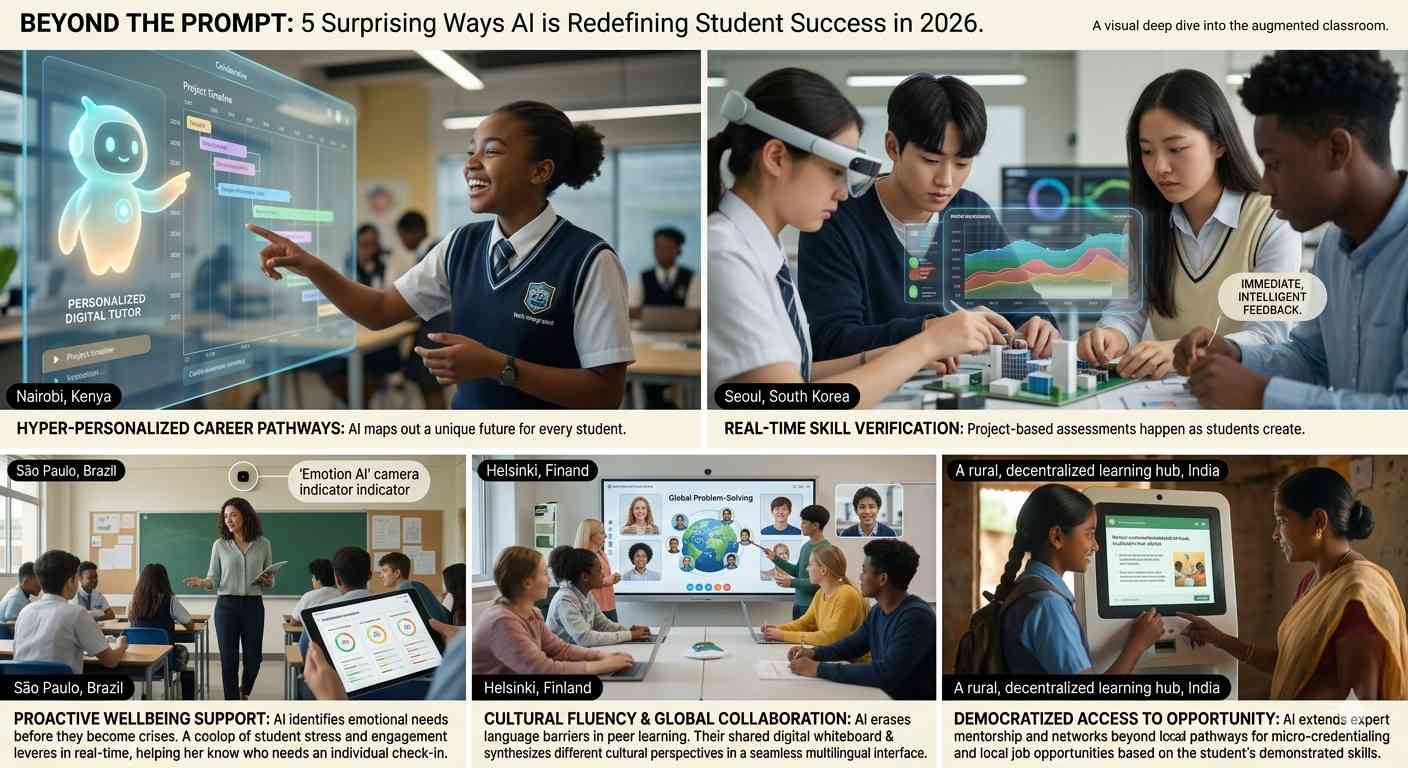
The Efficiency Trap: Moving from Preparation to Performance
For the modern student, the greatest barrier to academic success is rarely the complexity of the material—it is the sheer volume of “administrative” study tasks. You know the feeling: you spend four hours typing out lecture notes, formatting bibliographies, and manually creating flashcards, only to realize you are too exhausted to actually learn the content.
In 2026, high-performing students have realized that manual prep is a form of “productive procrastination.” Research from The Academic indicates that 86% of students now utilize AI not as a shortcut, but as “academic scaffolding”—a structural support system that handles the cognitive offloading of repetitive tasks. As your coach, my goal is to help you move from passive consumption to strategic, active learning. By treating AI as a “probabilistic knowledge synthesizer” rather than a simple search engine, you can reclaim your time for what matters: critical reasoning and original thought.
- Stop Typing, Start Testing: Why Manual Flashcards are a Learning Bottleneck
As a coach, I see students fall into the “Data Entry Trap” every day. You aren’t learning when you type; you are learning when you struggle to remember. Manual card creation is a waste of your most precious resource. Traditional workflows often involve 10 hours of typing for every hour of testing. In 2026, that ratio is inverted.
Using tools like StudyCards AI, you can convert a 50-page PDF into an Anki-ready deck in seconds. However, simply generating cards isn’t enough. You must perform a Quality Audit. AI can “hallucinate” or miss subtle legal or medical nuances. I tell my students: treat a hallucination as a learning opportunity. If you catch an AI error during your audit, you’ve just demonstrated a deep mastery of the material.
The “Atomic Card” Strategy For STEM and Medical students, the goal is “atomic” cards—one specific question per card.
- The Amateur Mistake: “Describe the symptoms of Diabetes Mellitus.” (Too broad; leads to rote memorizing of lists).
- The Pro Approach: “What is the primary symptom of hyperglycemia in Diabetes Mellitus?” (Specific, fast, and reinforces active recall).
“I used to spend my entire Sunday making Anki cards for my anatomy class. I would be so tired by the time I finished that I wouldn’t even start studying until Monday. Switching to StudyCards AI let me upload my lecture PDFs and have my deck ready in minutes. I actually have a life on the weekends now.” — Sarah, Medical Student
- The “Bot-Free” Revolution: Navigating Classroom Privacy and University Bans
While AI note-takers are essential for 2026, the method of recording is now a high-stakes decision. Many major institutions, including UC Riverside and the University of Pittsburgh, have begun blocking “meeting bots” that join online calls as visible participants. These bots are often viewed as intrusive and a violation of university privacy policies.
Furthermore, students have significantly higher volume requirements than the average professional. A “free” business tool capped at 20 hours a month will fail you by week two of the semester.
Comparison: Business vs. Academic Transcription Needs
Feature Professional Meeting Needs Student Lecture Needs (15 Credits)
Typical Monthly Volume ~20 hours/month 60+ hours/month
Primary Requirement Action items and CRM sync Technical terms and complex accents
Privacy Standards Corporate security University “Bot-Free” compliance
Data Usage Often used to train AI models Bluedot: Data never used for AI training
The Strategy: Use “bot-free” recording tools like Bluedot that capture audio through a browser extension or mobile app without appearing as a guest. While hardware solutions like Plaud are popular for in-person lectures, be warned: they carry a high entry cost ($169+) and frequently suffer from Bluetooth sync failures. For a reliable, compliant workflow, stick to software that respects the “bot-free” classroom.
- Structure Over Syntax: Using AI as a “Rehearsal Peer Review”
By 2026, using AI for grammar is like using a calculator for basic addition—it’s the bare minimum. Advanced students now use AI as a structural diagnostic tool. Writing at a doctoral or professional level is rarely an issue of “correct English”; it is a challenge of argumentative logic and evidence placement.
One of the most powerful “surprising” ways to use AI is to “write messy” first. Research on Non-native English Speakers (NNES) shows that the most efficient writers use AI to compose by writing broken, messy sentences to get their ideas down, then using AI to polish them. This eliminates “blank page syndrome” entirely.
The 3-Pass Diagnostic Workflow:
- Pass 1 (Structure): Use Thesify to identify if your argument “drifts” from your research aim. Use the “Suggested Topics” feature to see if you’ve actually answered your central research question.
- Pass 2 (Transitions): Use Writefull or Paperpal to refine topic sentences and ensure they align with the actual content of your paragraphs.
- Pass 3 (Evidence): Use AI to flag “unsupported claims” or “weak analysis” where a human reviewer would likely demand more evidence.
Treat this process as a “rehearsal peer review” before your supervisor ever sees the draft.
- Cognitive Offloading: The Interactive Query Refinement Loop
Elite students don’t use AI as a static encyclopedia; they use it as a partner for reasoning. Research by Mondal, Gazi, and Chowdhury defines ChatGPT as a “probabilistic knowledge synthesizer.” It doesn’t “know” facts the way a library does; it predicts the most logical synthesis of information.
To harness this, you must master the Interactive Query Refinement Loop. Instead of accepting the first response, use a multi-turn interaction to sharpen your own research questions.
The Loop: Ask\ a\ question \rightarrow Analyze\ the\ compressed\ output \rightarrow Refine\ the\ hypothesis \rightarrow Re-query\ the\ AI.
This process makes your own thinking “visible.” When the AI summarizes your messy notes, look for what it missed. Those gaps are where your true research resides. This is the transition from passive AI consumption to informed ethical co-creation.
- From Lists to Landscapes: The Power of Visual Research Mapping
In 2026, the traditional list-based literature search is dead. It has been replaced by Semantic Search—searching by meaning rather than exact keywords. Traditional keyword searches often miss critical research because they don’t understand the conceptual relationship between different terms (e.g., “mindfulness” vs. “attentional control”).
Visual mapping tools like Research Rabbit or Connected Papers allow you to “design” a literature review rather than just list papers. By entering one “seed” paper, you can generate a visual graph of nodes and edges to identify:
- Prior Works: The foundational studies that your specific research cluster is built upon.
- Derivative Works: Newer papers currently citing the foundational cluster.
These maps allow you to identify “research clusters” and “methodological traditions” visually. You aren’t just finding papers; you are seeing the history of a conversation.
Conclusion: The Human in the Loop
The common thread across all these strategies is that you remain the “Human in the Loop.” University policies (like those at Leeds or Northeastern) are clear: you are solely responsible for the reasoning, the accuracy of the claims, and the originality of your work.
AI is your academic scaffolding, not your replacement. It handles the data entry, the transcription, and the structural mapping so you can handle the heavy lifting of critical thought.
If AI can save you 10 hours a week on busy work, what will you do with that time to make your work truly original?
❓ తరచుగా అడిగే ప్రశ్నలు (FAQs)
ఈ వార్త లేదా కథనంలో ముఖ్యమైన అంశం ఏమిటి?
Beyond the Prompt: 5 Surprising Ways AI is Redefining Student Success in 2026 గురించిన పూర్తి సమాచారం మరియు తాజా ముఖ్యాంశాలు ఈ కథనంలో సమగ్రంగా వివరించబడ్డాయి.
ఈ తాజా పరిణామం ఎందుకు ప్రాధాన్యత సంతరించుకుంది?
ప్రజా ప్రయోజనాలు, సంబంధిత వర్గాలు మరియు ప్రస్తుత పరిస్థితుల దృష్ట్యా ఈ పరిణామం అత్యంత కీలకమైనదిగా మారింది.
ఈ అంశంపై అధికారిక వివరాలు మరియు తాజా అప్డేట్స్ ఎక్కడ తెలుసుకోవచ్చు?
సంబంధిత అధికారిక వర్గాలు వెల్లడించే తదుపరి సమాచారం మరియు ప్రత్యక్ష అప్డేట్స్ కోసం మా వెబ్సైట్ను నిరంతరం ఫాలో అవ్వండి.