
The Moment AI Got a Physical Body
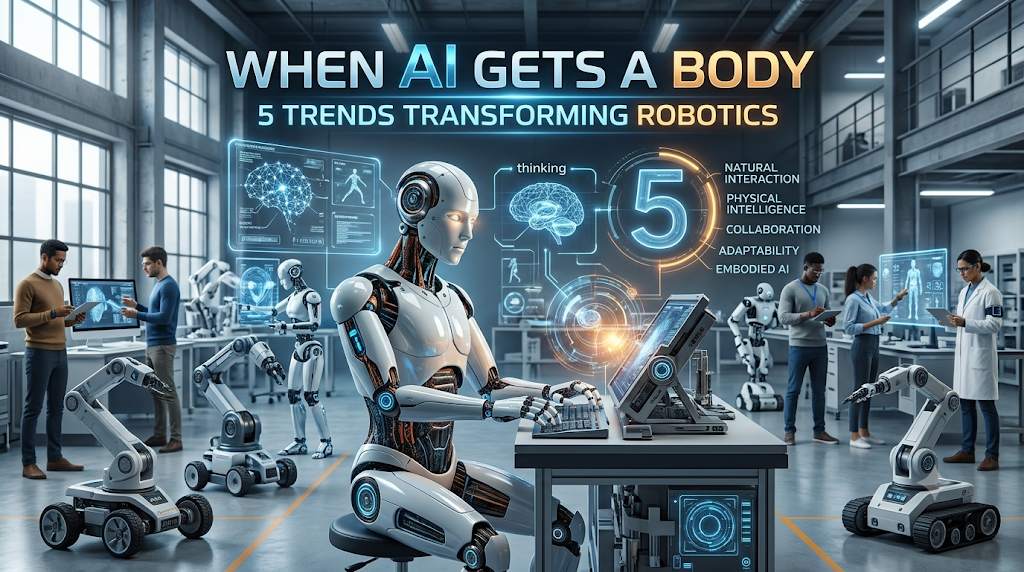
For years, generative artificial intelligence existed entirely behind digital screens—drafting text, generating images, and writing lines of code. But in 2026, the technological frontier has dramatically shifted toward “Physical AI”: giving artificial intelligence its own physical body to interact directly with the real world.
Robotics has reached a historic inflection point. The global robotics market has surged to $38 billion in 2026—a 34% year-over-year increase that marks the fastest growth rate the sector has seen in a decade. We are witnessing a fundamental transition away from rigid, hand-programmed factory arms locked behind safety cages. In their place, a new generation of autonomous, embodied systems has emerged—machines capable of perceiving their environments, reasoning through complex spatial tasks, and continuously learning from physical experience.
Driven by breakthroughs in agentic software, space-based construction, hardware commoditization, and proactive safety regulations, Physical AI is moving from research laboratories directly into commercial deployment. Here are the top five most impactful trends reshaping the robotics landscape right now.
1. The Data Bottleneck Is Cracking: How AI Agents Learned to Program Physical Hardware
For years, roboticists warned of a daunting “100,000-year data gap.” Unlike large language models that trained on trillions of words scraped from the internet, physical robots lacked a comparable pool of real-world interaction data. Collecting millions of human demonstrations via manual teleoperation was slow, expensive, and difficult to scale.
That data bottleneck is now cracking thanks to a paradigm shift known as agentic robotics, pioneered by UC Berkeley Professor Ken Goldberg and researchers at NVIDIA. Instead of relying solely on massive real-world datasets or manual engineering, agentic robotics uses teams of AI agents to autonomously generate, simulate, test, and refine robot-control code. Using software frameworks like Graph-as-Policy alongside NVIDIA Isaac simulation libraries and advanced models like OpenAI’s Astra, AI agents segment complex tasks into modular skills, test programs across simulated variations, identify failure modes, and update the robot’s code without human intervention.
“This is when I got goosebumps.”
— Ken Goldberg, UC Berkeley Roboticist and Professor of Engineering
Goldberg experienced this breakthrough moment when his team provided an AI agent with a short video of a physical trial where a robot failed to wipe ink off a metal bar because it misjudged the bar’s mass. In less than an hour, the agent analyzed the video, created a physics-accurate simulation, revised the robot’s control program, and successfully executed the task on physical hardware.
Key Industry Metrics: Data Economics & AI Adoption
- Teleoperation Data Cost: Dropped 60%, from $340/hour in 2024 to $118/hour in 2026.
- Dominant Training Method: Imitation Learning (61%) officially surpassed Reinforcement Learning (31%).
- VLA Model Deployments: Vision-Language-Action models now power 40% of all new robotic deployments.
This software framework is not just a university experiment—it has achieved direct commercial validation. Berkeley-based Ambi Robotics implemented agentic AI methods across 30% of its U.S. logistics fleet to analyze parcel-sorting data and autonomously update robot behaviors. The result was an annual throughput increase of over 15,000 sorted packages per robot while keeping human engineers in supervisory control.
This transformation fundamentally changes how physical hardware is developed: moving robotics from slow, manual engineering into continuous, self-improving software feedback loops.
2. Beyond Rocket Fairings: Autonomous Orbital Construction Has Arrived
For decades, the maximum dimensions of space structures—from communication satellites to orbital telescopes—were strictly limited by the physical inner diameter of a rocket’s payload fairing. If a structure could not be folded into a compact package or assembled manually by astronauts, it simply could not exist in space.
That constraint was broken on March 30, 2026, when the Autonomous In-Space Tensioned Reflector Assembly (ASTRA) experiment launched aboard a SpaceX Transporter-16 mission, hosted on Momentus Inc.’s Vigoride 7 orbital vehicle. Developed by researchers at Caltech with funding from DARPA’s Novel Orbital and Moon Manufacturing, Materials, and Mass-efficient Design (NOM4D) program, ASTRA demonstrated the first autonomous robotic construction of a structural framework in orbit without astronaut intervention.
                  ASTRA ORBITAL ASSEMBLY WORKFLOW

   [ Automated Storage Dispensers ]
                  │
                  ▼ (Retrieve Composite Fiber Tubes & Connectors)
   [ Robotic Arm Assembly Plate ]
                  │
                  ▼ (Build Repeating Structural "Bays")
   [ Extended Space Truss Framework ]
                  │
                  ▼ (Attach Tensioned Reflective Surface)
   [ Completed Orbital Reflector Antenna ]
The system utilized a robotic arm to retrieve composite fiber tubes and aluminum connectors from motorized dispensers, systematically joining them to build structural “bays” that extended outward into space. To construct a 1.4-meter reflector antenna while minimizing launch mass, researchers at Caltech and the University of Pennsylvania (led by Prof. Igor Bargatin) developed a lightweight reflective surface using perforated Kapton film suspended between two cable nets held under spring tension.
Operating hundreds of miles above Earth required solving unexpected physical anomalies during brief 15-minute communication windows. To troubleshoot orbital issues, Caltech engineers operated a physical “flight spare” laboratory twin on Earth to mirror orbital problems, test code adjustments, and transmit verified assembly commands back to space. Although scheduling and technical constraints prevented assembling all 11 planned bays, ASTRA successfully constructed an initial orbital truss bay section, proving the viability of autonomous space manufacturing.
“NOM4D’s objective is to enable efficient, scalable construction of very large structures in space… By ‘very large,’ I mean hundreds of meters or kilometers in scale. Nothing approaching that scale can be achieved today.”
— Andrew Detor, DARPA Program Manager
The success of in-space autonomous assembly breaks the physical limits of launch vehicles, paving the way for kilometer-scale space structures, giant deep-space telescopes, massive communication arrays, and space-based solar power stations that harvest clean energy in orbit and wirelessly transmit it to Earth.
3. The 5-Million Milestone: China’s Gravitational Pull on Global Hardware
Industrial automation has officially hit mass scale. According to the International Federation of Robotics (IFR), the global operational stock of industrial robots reached a record 5 million units (a 9% increase), with annual factory installations exceeding 600,000 units worldwide.
| Global Hardware & Market Dynamics | 2026 Industry Benchmark |
| Global Operational Robot Stock | 5,000,000 units (+9% YoY) |
| China Deployment Share | 59% of global installations (354,000 units/year) |
| Humanoid Manufacturing Share | China produces ~80% of global humanoid platforms |
| Sub-$10,000 OEM Robotic Arms | Chinese OEMs produce 8 out of 14 market models |
| Hardware Lead Times (Shenzhen) | Compressed to 10–14 days (vs. 12 weeks in West) |
China has established an overwhelming gravitational pull on global robotics hardware manufacturing. This dominant market presence is driven by three powerful structural forces:
- Supply Chain Density: In hardware manufacturing hubs like Shenzhen, component lead times for standard robotic configurations have compressed to just 10–14 days, compared to 12 weeks in Western markets.
- State Industrial Policy: China’s Ministry of Industry and Information Technology (MIIT) executed a dedicated Humanoid Robot Action Plan, establishing an explicit national target to deploy 100,000 humanoid units by 2027.
- Anchor Demand: Industrial giants like BYD, CATL, and Foxconn deploy tens of thousands of robots across high-volume battery and EV assembly lines, generating massive real-world demonstration datasets that feed back into policy training.
This massive scale has accelerated hardware commoditization. As high-performance six- and seven-degree-of-freedom (DoF) robotic arms become standardized components, physical hardware is no longer a durable competitive moat. Enterprise value is rapidly shifting up the software stack toward proprietary training datasets, fine-tuned policy libraries, synthetic simulation pipelines, and reliable integration infrastructure.
4. Out of the Cage: Cobots Enter ‘Dirty, Dull, and Dangerous’ Jobs—and Dining Rooms
Collaborative robots (cobots) and Autonomous Mobile Manipulator Robots (AMMRs)—which fuse a robotic arm with a mobile platform—are breaking out of traditional factory enclosures and stepping directly into shared human environments.
2026 cobots offer industrial-grade payload capacities, extended reach, and high precision, coupled with natural-language interfaces like NVIDIA NemoClaw and Generative AI frameworks such as ABB’s AVR™ (Autonomous Versatile Robotics) vision. Operators no longer program line-by-line code; instead, they instruct robots using natural voice or text commands, which software instantly converts into executable motion paths.
Key Non-Traditional Cobot Applications
- Food Service & Kitchens: Over 340 quick-service restaurant (QSR) locations operate robotic kitchen assistants for flipping burgers and frying foods to manage post-pandemic labor shortages.
- Surgical Coordination: Operating rooms utilize PeritasAI with NVIDIA Isaac for Healthcare and the Rheo workflow blueprint to manage sterile surgical instruments alongside clinical teams.
- Sustainable Agriculture: Aigen deploys solar-powered weeding rovers that run vision AI on NVIDIA Jetson Orin modules, identifying and mechanically removing weeds to eliminate chemical herbicides.
- Adaptive Palletizing: Doosan Robotics integrates NVIDIA Cosmos Reason into warehouse cobots, analyzing single camera frames to infer box contents, inspect damage, and dynamically adjust grip speed and force based on weight and fragility.
Driven by persistent labor shortages in post-pandemic markets, businesses are adopting hybrid operational models where cobots reliably execute repetitive or hazardous physical labor, allowing human workers to focus on higher-level supervisory and customer-facing roles.
5. Security Is Safety: Why Cyberattacks Are Now Regulated as Physical Hazards
As physical machinery becomes continuously connected to cloud networks, edge servers, and AI training pipelines, cybersecurity has ceased to be a purely IT concern. Engineering teams are preparing for a major legal regulatory transition: in 2027, new European directives come into full legal enforcement, making 2026 the critical engineering transition year for compliance.
Three unified legal frameworks and technical standards govern this landscape:
- The EU Machinery Regulation (EU 2023/1230): Directly applicable across all EU member states, this law mandates that network-connected machinery be cybersecure by design, formally recognizing that a network breach poses a direct physical danger to human operators.
- The EU Cyber Resilience Act (CRA): Mandates lifecycle vulnerability management, requiring hardware and software vendors to provide continuous security patches and technical support.
- ISO 10218:2025 Standard: The international technical standard providing precise integration guidelines to ensure robotic workcells comply with both the Machinery Regulation and the CRA.
Under these regulations, authorities no longer evaluate a robot arm in isolation; they evaluate the entire workcell application as a single complete machine. Attaching a new gripper, sensor, or tool to a cobot arm triggers mandatory safety and cybersecurity risk assessments for the entire workstation.
               THE NEW REGULATORY COMPLIANCE MATRIX

┌──────────────────────────────────┬──────────────────────────────────┐
│ Legacy Safety Approach           │ Enforceable Regulatory Framework │
├──────────────────────────────────┼──────────────────────────────────┤
│ Evaluated robot arm in isolation │ Evaluates entire workcell system │
│ Physical safety cages only       │ Cybersecurity = Physical Safety  │
│ Unmonitored network connections  │ Mandatory cyber-resilience (CRA) │
│ Manual, periodic safety checks   │ Continuous status & event logging│
│ Internal incident handling       │ Mandatory reporting to ENISA     │
└──────────────────────────────────┴──────────────────────────────────┘
Furthermore, ISO 10218:2025 mandates continuous status logging—recording robot positions, motion trajectories, speed variations, parameter modifications, and software update histories. Any cyber incident that compromises safety systems must be formally reported to agencies like the European Union Agency for Cybersecurity (ENISA).
Leading hardware manufacturers are building these requirements directly into their control architectures. Kawasaki Robotics introduced its Core Cubic-S safety controller as an integrated, native feature. The system tracks up to 17 axes, handles 32 physical safety I/O signals, manages role-based access directly on the Teach Pendant, and continuously logs operational data—providing the audit trails required under the new legal framework.
While compliance requires rigorous engineering, these standardized safety rules give enterprises the legal clarity required to deploy autonomous robot fleets alongside human workers at scale.
The Next Frontier of Embodied Intelligence
The physical AI revolution is no longer a theoretical promise confined to academic papers. The convergence of commoditized hardware, falling teleoperation data costs ($118/hour), agentic coding models, and enforceable safety standards has brought artificial intelligence firmly into the physical world.
As robots move off factory floors to build structural frameworks in orbit, coordinate surgical tools in operating rooms, and navigate agricultural fields, the boundaries between software and physical machinery are disappearing.