
AI Project Management Tools
-

Notion AI
Enhance productivity with AI-driven content generation and analysis.
-
AirOps
Task-specific AI apps for running NLP, generating data-informed content, and optimizing SQL queries.
-
IngestAI
A comprehensive platform for leveraging AI capabilities through workflows and low-code tools.
-
Roamaround
Unleash insights with AI-driven data mapping and collaborative visualization.
-
Taskade
Unify team productivity with AI-driven task management and collaboration.
-
Arcwise
AI-driven tool streamlines spreadsheet tasks, boosting productivity.
-
Soofy
Streamline tasks, analyze data, and enhance decision-making with AI-powered efficiency.
-
Ideabuddy
Turn ideas into business realities with structured planning and financial tools.
-
Pebblely
Unleash AI-driven insights and automation for enhanced productivity across various sectors.
-
Jigso
Optimize tasks, automate alerts, and retrieve data seamlessly.
-
Vondy AI
Comprehensive AI creativity and productivity assistant.
-
Supermanage AI
Transform team management with AI-driven insights and automation.
-
GitMind AI
AI-enhanced mind mapping for dynamic collaboration and creativity.
-
PromptDrive.ai
All-in-one AI prompt management tool for teams.
-
Luminal
Unlock productivity with AI-driven automation, analytics, and scalable workflows.
-
Noty.ai
AI-driven tool that transcribes, summarizes, and organizes meeting tasks.
-
Spoke.ai
AI-powered tool that revolutionizes team communication and project management.
-
Proposal Genie
Automates personalized, effective proposal creation for freelancers and small businesses.
-
Helper
Provides direct access to ChatGPT within favorite apps to eliminate context switching.
-
PromptFolder
Centralize and streamline AI prompt management with organizational tools and a Chrome extension.
-
dotBRAND
AI tool designed to streamline design project management and client interactions.
-
Tekmatix
All-in-one CRM, online business, and course creation platform.
-
Pth.AI
Empower professional goals with AI-driven insights, tailored action plans, and intuitive navigation.
-
Roboflow
Empower AI projects with intuitive computer vision tools, training, and deployment.

1. Introduction: The End of Project Management as We Know It
For decades, the business world has accepted “project chaos” as an inevitable tax on innovation. We have historically tolerated a staggering rate of project failure, viewing fragmented data, shifting timelines, and the “planning fallacy” as the cost of doing business. In this old paradigm, project management software was little more than a digital filing cabinet—a passive repository that required constant, manual feeding to remain even remotely accurate.
By 2026, that era of manual struggle has officially ended. We are witnessing a fundamental shift from passive tools to AI-powered resources that do not just track work—they redefine what is possible. The modern toolkit has evolved from static Gantt charts into a suite of intelligent agents capable of smart automation and predictive foresight. For the strategic leader, this isn’t just a productivity boost; it is a total reimagining of the project life cycle, turning complexity into a distinct competitive advantage.
2. Takeaway 1: AI as a Predictive Architect, Not Just a Scheduler
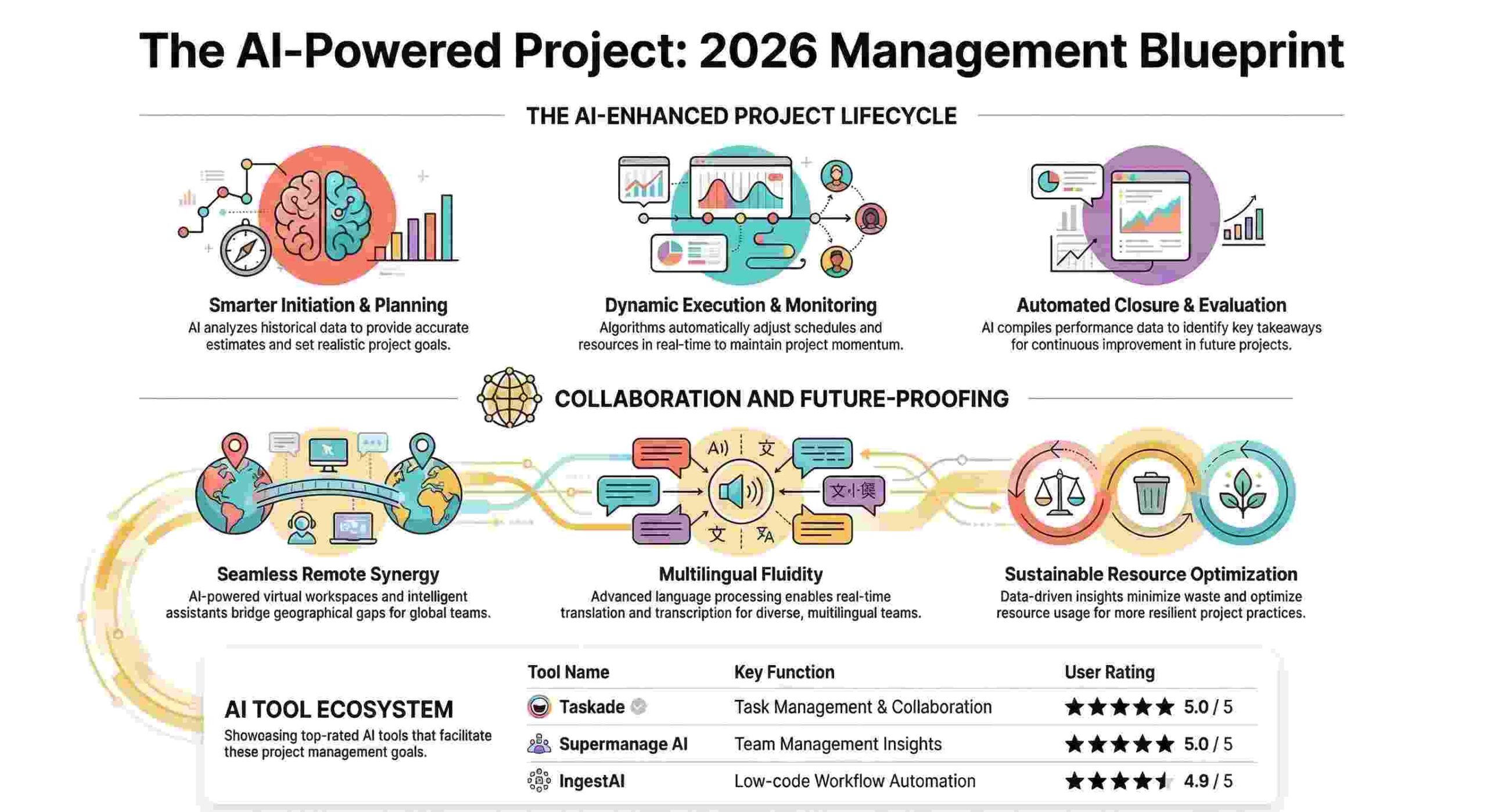
In the traditional 2024 model, project planning was largely an exercise in educated guessing. Managers would estimate timelines based on “gut feel” or incomplete spreadsheets, often leading to immediate delays. In 2026, the PM role has shifted from guessing to strategizing. AI now acts as a predictive architect, cannibalizing the manual labor of risk assessment by analyzing vast troves of historical data to identify hurdles before they manifest.
“AI project management tools step up your game, transforming challenges into opportunities and complexity into clarity.”
By using these predictive capabilities, organizations no longer react to crises; they architect outcomes. This shift ensures that goals are grounded in data-driven reality, providing a solid foundation that allows human leaders to focus on high-level creative problem-solving rather than fire-fighting.
3. Takeaway 2: The Death of Context Switching via Integrated Intelligence
For years, we’ve paid a “switching tax”—the cognitive drain caused by jumping between dozen of apps to find a single data point. The 2026 landscape has cured this through integrated intelligence. Helper has become a cornerstone of this shift, providing direct access to ChatGPT within existing applications and eliminating the need for context switching entirely.
While Helper brings the intelligence to where the work is happening, tools like Jigso allow teams to optimize tasks and retrieve data seamlessly across the stack. This isn’t just about speed; it’s about maintaining a state of “flow.” When the intelligence of the project remains embedded in the workflow, the friction of the modern workspace evaporates.
4. Takeaway 3: Spreadsheets and SQL Are Becoming “Natural Language” Interfaces
The technical silos that once separated “data people” from “project people” have been dismantled. AI is democratizing data-informed decision-making by turning technical hurdles into simple, natural language actions.
- Arcwise has revolutionized the spreadsheet, streamlining complex tasks that used to require hours of manual formula building.
- AirOps allows project managers to act as data scientists, using task-specific AI to draft, fix, and optimize SQL queries.
Crucially, AirOps also generates data-informed content, bridging the gap between raw numbers and executive-ready reporting. This ensures that every team member, regardless of technical background, can leverage deep data insights to drive the project forward.
5. Takeaway 4: Project “Closure” Is the New Competitive Advantage
Historically, the “Closure” phase of a project was a bureaucratic afterthought—a wrap-up meeting and a forgotten folder. In 2026, AI has transformed this into a strategic asset. By facilitating the efficient compilation of data and performance analysis, AI turns “tribal knowledge” into institutional intelligence.
This is how organizations future-proof themselves. AI identifies key takeaways and specific areas for improvement, ensuring that the organization learns from every mistake and optimizes every success. Closure is no longer an endpoint; it is a high-value data injection that ensures the next project starts with a massive head start, turning past performance into a continuous competitive advantage.
6. Takeaway 5: Breaking the Global Barrier with Real-Time Translation
In our globalized reality, distance and language were once significant friction points that slowed down synchronized efforts. Today, AI-enhanced collaboration tools have turned global distance into a non-issue. Through advanced language processing, AI provides real-time translation and transcription, ensuring that a developer in Tokyo and a designer in Berlin are perfectly aligned in the same virtual workspace.
“AI project management tools are now at the heart of team collaboration.”
By creating environments that adapt to team needs, AI ensures that communication is clear and that the “human” element of the project remains synchronized, regardless of the mother tongue or time zone.
7. Takeaway 6: Automated Accountability via Intelligent Assistants
We are seeing the end of the “micromanagement era.” In 2026, the burden of chasing updates and checking in on tasks has been offloaded to intelligent assistants. This shift from manual oversight to automated accountability has redefined team cohesion.
- Taskade unifies team productivity by using AI to manage task flows and collaboration.
- Supermanage AI transforms team management by providing automated insights that human managers would likely miss.
- Execution and Monitoring: AI algorithms now automatically adjust schedules and resources in response to real-time changes, maintaining momentum without the need for a human to manually re-level every resource.
8. Conclusion: Toward a Predictable Future
The integration of AI into the project life cycle is moving us toward a future where outcomes are no longer “hoped for” but predicted. Beyond simple efficiency, these tools are fostering sustainable practices by using data-driven insights to optimize resource usage and minimize waste, ensuring that every hour of human effort is spent on what matters most.
As complexity ceases to be a hurdle and becomes a tool, we must ask: How will your role as a leader evolve when you are no longer managing tasks, but orchestrating intelligence?
❓ తరచుగా అడిగే ప్రశ్నలు (FAQs)
ఈ వార్త లేదా కథనంలో ముఖ్యమైన అంశం ఏమిటి?
Predictive, Not Reactive: Why the Best Project Manager in 2026 Isn’t Human గురించిన పూర్తి సమాచారం మరియు తాజా ముఖ్యాంశాలు ఈ కథనంలో సమగ్రంగా వివరించబడ్డాయి.
ఈ తాజా పరిణామం ఎందుకు ప్రాధాన్యత సంతరించుకుంది?
ప్రజా ప్రయోజనాలు, సంబంధిత వర్గాలు మరియు ప్రస్తుత పరిస్థితుల దృష్ట్యా ఈ పరిణామం అత్యంత కీలకమైనదిగా మారింది.
ఈ అంశంపై అధికారిక వివరాలు మరియు తాజా అప్డేట్స్ ఎక్కడ తెలుసుకోవచ్చు?
సంబంధిత అధికారిక వర్గాలు వెల్లడించే తదుపరి సమాచారం మరియు ప్రత్యక్ష అప్డేట్స్ కోసం మా వెబ్సైట్ను నిరంతరం ఫాలో అవ్వండి.