
1. The Gap Between AI Hype and Clinical Reality
Every week brings sweeping declarations of an imminent artificial intelligence revolution across healthcare. Headline narratives promise autonomous diagnostic algorithms, AI-powered virtual physicians, and fully automated clinical care pathways. Yet, when walking the halls of real-world hospitals, health systems, and frontline clinical environments, the operational reality behind the scenes is far more complex, surprising, and measured than the marketing hype suggests. While machine learning and neural networks hold genuine potential to transform diagnostics, operational workflows, and patient care, the actual implementation of these tools faces rigid regulatory boundaries, workforce readiness challenges, and complex integration hurdles.
The journey of bringing AI into modern clinical practice is not a straightforward story of instant disruption. Instead, it is defined by subtle paradigms, unexpected regulatory roadblocks, and practical engineering trade-offs. To navigate this evolving landscape effectively, clinicians, health system leaders, and technology strategists must look beyond consumer hype and examine the empirical realities driving medical delivery today. What follows is a distilled analysis of the top six counter-intuitive takeaways reshaping modern medical technology.
2. The FDA Has Approved 600+ AI Devices—but Zero Are Powered by Generative AI or LLMs
Despite the intense public interest in Large Language Models (LLMs) and consumer-facing conversational engines like ChatGPT, the regulatory reality of Artificial Intelligence as a Medical Device (AIaMD) tells a drastically different story. Out of the 692 US Food and Drug Administration (USFDA)-cleared AI and machine learning-enabled medical devices recorded as of July 2023—with over 500 approved in radiology alone—zero rely on generative AI, Large Language Models, or Artificial General Intelligence (AGI).
Approved USFDA AI/ML Devices by Clinical Category (as of July 2023)
- Radiology: 531 devices
- Cardiovascular: 71 devices
- Neurology: 20 devices
- Hematology: 15 devices
- Gastroenterology / Urology: 11 devices
- Ophthalmic: 9 devices
- Anesthesiology: 6 devices
- Clinical Chemistry: 6 devices
- Microbiology: 5 devices
- General and Plastic Surgery: 5 devices
- Pathology: 4 devices
- General Hospital: 3 devices
- Ear, Nose & Throat: 2 devices
- Dental, Immunology, Obstetrics & Gynecology, Orthopedic: 1 device each
This stark regulatory divide exists because established medical device evaluation frameworks are built upon static, risk-based classification pathways (primarily Class II in the United States and Class IIa under the European Union Medical Device Regulation). Traditional Software as a Medical Device (SaMD) relies on locked, deterministic algorithms or narrow machine learning models designed to execute explicit tasks—such as segmenting organ volumes, detecting lung nodules on CT scans, or flagging atrial fibrillation on an ECG—within tight, pre-specified parameters.
In contrast, generative models and continuous-learning architectures present moving targets for regulators. Because generative AI systems operate on probabilistic foundation models, outputs vary dynamically based on prompts. This introduces a continuous risk of non-reproducible outputs, algorithmic “hallucinations,” behavioral drift away from baseline training data, and unpredictable performance across diverse clinical populations. Consequently, while standard SaMD models fit neatly into static premarket submissions, generative AI faces stringent re-evaluation and emerging “high risk” classification under upcoming frameworks like the EU AI Act.
Comparative Breakdown: Standard SaMD vs. Generative AI in Clinical Practice
- Algorithmic Architecture: Standard SaMD relies on locked, narrow machine learning models (e.g., convolutional neural networks for image classification). Generative AI relies on complex probabilistic foundation models and LLMs that generate novel synthetic text or synthetic data.
- Regulatory Status & Risk Classification: Standard SaMD possesses established premarket clearance pathways under Class II (USFDA) or Class IIa (EU MDR) frameworks. Generative AI lacks harmonized global clearance pathways for autonomous clinical decision support and faces proposed “high risk” designation under the EU AI Act.
- Performance Stability & Validation: Standard SaMD provides predictable, reproducible outputs validated against static benchmark datasets. Generative AI carries an inherent risk of dynamic output variation, output hallucination, and behavioral shift across varying clinical prompts.
- Regulatory Adaptability & Surveillance: Standard SaMD updates are governed by static re-evaluations or structured Predetermined Change Control Plans (PCCPs). Generative AI requires novel governance structures for continuous real-world safety monitoring, output verification, and retraining guardrails.
3. AI Cybersecurity Is a Double-Edged Sword—and a $1.9 Million Defense
As health systems expand their digital infrastructure to support data-heavy AI models, their attack surface widens exponentially. In hospital environments, AI functions simultaneously as an aggressive threat multiplier for cybercriminals and an indispensable shield for security operations. Threat actors actively deploy machine learning tools against healthcare networks across eight specific vectors identified by federal security analyses:
- Automated development of highly convincing phishing emails.
- Audio and video impersonation attacks (“deepfakes”).
- Rapid, automated exploitation of software vulnerabilities.
- Automated generation of complex malware code.
- Deeper, automated target reconnaissance of hospital networks.
- Automation and scaling of attack vectors.
- Targeted flooding designed to overwhelm human security teams.
- Deployment of wider, more evasive ransomware strains.
The financial impact of this digital arms race is staggering. According to the IBM and Ponemon Institute Cost of a Data Breach Report, healthcare suffered the highest average data breach cost of any industry in 2024, reaching $9.8 million per incident—nearly double the cross-industry average of $4.9 million.
The Financial and Operational Impact of AI Defenses (2024 Data)
- Healthcare Average Breach Cost (Overall Industry): $9.8 Million
- Healthcare Breach Cost Without AI Defenses: $5.7 Million
- Healthcare Breach Cost With AI Defenses: 3.8 Million (**1.9 Million Net Savings**)
- Identification & Containment Time Without AI Defenses: 228 Days
- Identification & Containment Time With AI Defenses: 158 Days (70 Days Faster Containment)
Healthcare organizations leveraging AI-driven security defenses—such as automated threat detection, continuous telemetry monitoring, predictive cyberthreat analysis, and automated incident handling—cut breach costs from $5.7 million down to 3.8 million, achieving a **1.9 million net savings**. Furthermore, AI-enabled defenses identified and contained security incidents 70 days faster than non-AI implementations (158 days versus 228 days).
Yet, despite the powerful protective layer offered by advanced computational shields, health system leaders stress that technology must protect the human element at the point of care rather than replace it.
“Health care is, and will always be, a uniquely human experience. That’s why it’s no surprise that some of AI’s most transformative — and likely most tightly regulated — capabilities exist at the point of care: the human-to-human interface.” — Chris DeRienzo, M.D., Chief Physician Executive, American Hospital Association
4. Healthcare AI Is a “People Sport” Led by the C-Suite, Not an IT Project
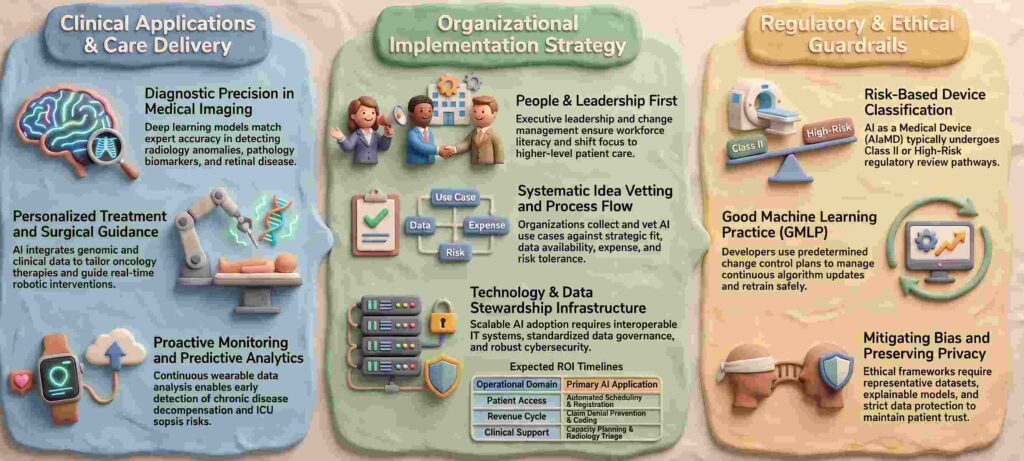
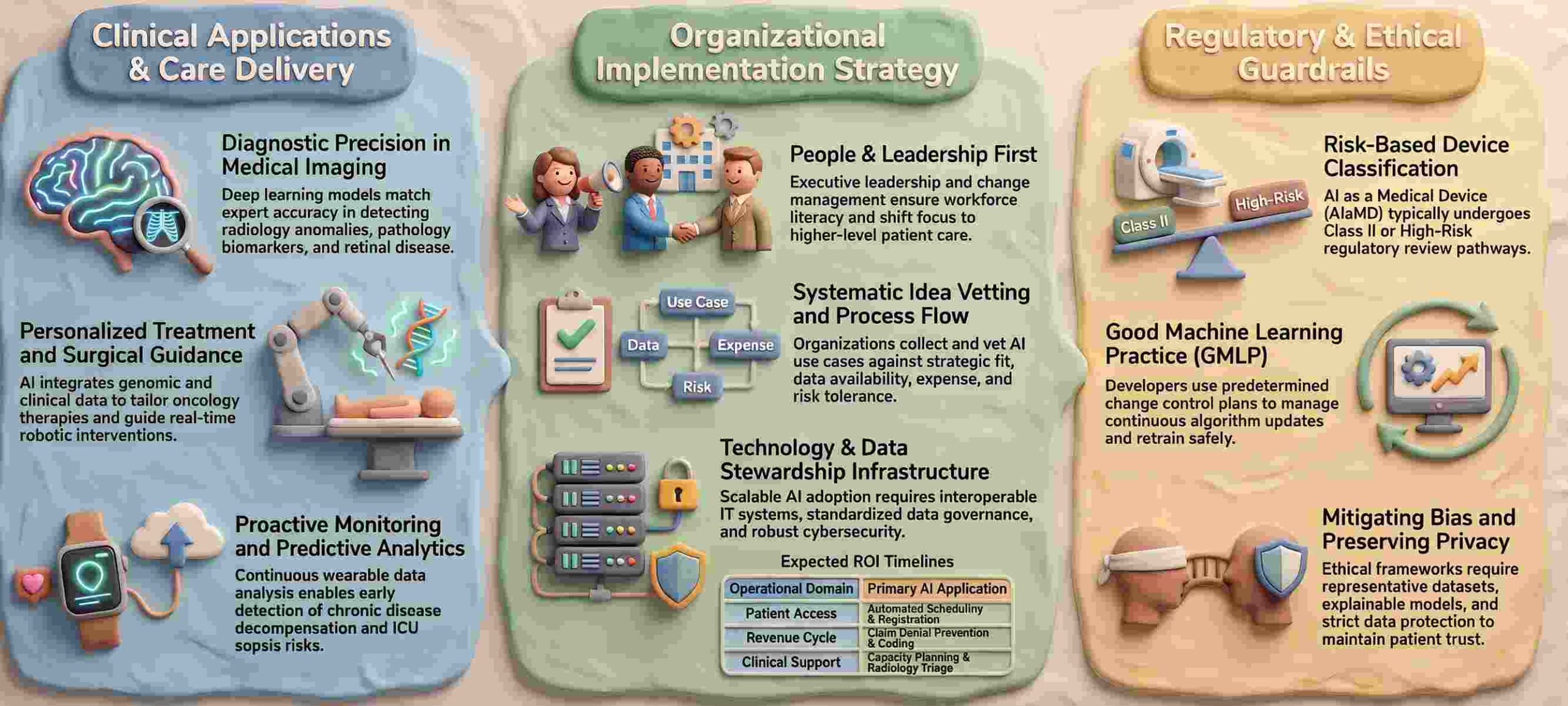
A primary failure mode in digital health transformation is treating AI integration as a traditional IT software rollout. In clinical environments, AI implementation is fundamentally a human, cultural, and organizational challenge. Recent executive survey data reveals a sharp strategic disconnect between technological enthusiasm and operational readiness:
- 85% of surveyed health system leaders cite AI as the most exciting emerging technology in healthcare.
- 68% of surveyed health system executives cite a workforce “not ready to implement new technology” as a top-three barrier to executing transformation over the next two years.
Because AI algorithms fundamentally alter daily clinical routines, record-keeping, and decision-making workflows, successful deployment requires active change management. Changing how work is done changes the culture of an organization. Equipping medical staff with AI literacy allows clinical teams to offload repetitive, labor-intensive tasks and reallocate valuable time toward nuanced clinical judgment, complex decision-making, and empathetic patient interactions.
Consequently, progressive health systems recognize that AI execution must be championed by C-suite leaders—such as a Chief Innovation Officer, Chief Digital Officer, Chief Strategy Officer, Chief Transformation Officer, or Chief AI Officer—working alongside executive leadership. This signals that the AI journey is a structural transformation rather than a transactional software upgrade.
Dr. Kaveh Safavi cleanly encapsulates the foundational mindset required for executive leadership:
“The first question the C-suite often asks when technology like generative AI falls from the sky is, ‘What does it do?’ The question they should ask is, ‘What should it do?’ You can’t answer the second question by starting with technology. You answer it by starting with the business problem you’re trying to solve.” — Kaveh Safavi, M.D., Senior Managing Director of Health, Global Healthcare Practice, Accenture
This shift in executive perspective—moving from high-level strategic alignment to physical infrastructure—highlights why health systems are increasingly rethinking how and where AI computations take place.
5. The Real Revolution Is Moving AI to the “Edge” (Beyond Cloud Dependency)
While centralized cloud servers power extensive data aggregation and retrospective research, point-of-care clinical execution is rapidly shifting toward Edge Computing. Edge computing processes physiological data locally at the hardware level—on individual medical devices, smart sensors, or point-of-care instruments—rather than transmitting raw datasets back and forth across remote cloud networks.
Instead of sending patient data to a distant cloud server and waiting for processed analytics to return across high-latency networks, edge computing creates a closed, localized processing loop directly at the endpoint device.
Three Core Operational Imperatives Driving Edge AI in Healthcare
- Latency & Real-Time Speed: Critical physiological monitoring demands instant response times. For example, edge-powered wearable ECG patches continuously analyze cardiac electrical activity on the spot to detect arrhythmias instantaneously, bypassing the latency inherent in cloud processing. This real-time detection speed is vital during acute, time-sensitive clinical events such as strokes or sudden cardiac episodes.
- Data Privacy & Regulatory Compliance: Processing sensitive Protected Health Information (PHI) locally minimizes the need to stream raw patient data over external networks. Keeping sensitive health records on the local edge node significantly reduces breach exposure and simplifies compliance with strict statutory frameworks like HIPAA and GDPR.
- Offline Functionality & Resource-Limited Settings: In rural clinics, low-resource communities, or moving ambulances where internet and cellular connectivity can be spotty or non-existent, edge devices remain fully operational. For instance, portable point-of-care ultrasound (POCUS) devices equipped with local edge AI can interpret diagnostic scans and assist non-specialist operators without relying on an active cloud connection. Similarly, smart insulin pumps monitor glucose trends continuously on the device, adjusting insulin delivery and alerting patients to anomalies without needing internet access.
Engineering Trade-offs of Edge Deployments
Despite these performance advantages, deploying AI to edge devices introduces distinct engineering and capital trade-offs. Specialized edge hardware requires significant upfront capital investment. Maintaining device interoperability across disparate hardware manufacturers, protecting physical edge nodes against local cybersecurity tampering, and managing software updates across thousands of decentralized devices present continuous operational challenges for health system IT teams.
6. Selecting an AI Tool? Choosing by Brand Instead of “Task” Is a Fatal Mistake
A widespread operational error among clinical leaders and health systems is evaluating AI software based on brand recognition rather than defining the specific clinical job to be done. A tool optimized for literature retrieval is fundamentally unsuited for medical examination prep or OSCE simulation, just as an ambient documentation engine cannot provide guideline-grounded differential diagnostics.
To maximize clinical utility and financial value, AI tools must be evaluated strictly against task-specific functional requirements.
| Clinical Task Category | Optimal Tool Criteria & Requirements | Available Market Solutions & Examples |
| Clinical Evidence Retrieval | Requires direct source visibility, verified citations, explicit guideline mapping (e.g., NICE, CKS, SIGN), transparent handling of uncertainty, and literature synthesis. | Ask-iatroX, OpenEvidence, UpToDate Expert AI, Dyna AI, ClinicalKey AI |
| Exam Prep & Medical Simulation | Requires curriculum blueprint mapping, adaptive question banks, Socratic tutoring targeted to misconceptions, OSCE simulation tracks, and progress tracking. | iatroX, AMBOSS, Geeky Medics, Quesmed, Neural Consult |
| Documentation & Workflow | Requires Natural Language Processing (NLP), ambient voice recognition, structured EHR data extraction, and automated ICD-10/CPT coding capabilities. | Commercial EHR-integrated NLP assistants, voice dictation software |
Before buying individual software subscriptions, clinicians and department leads should perform an institutional audit. Large healthcare systems and academic institutions frequently provide enterprise-wide access to platforms like UpToDate, ClinicalKey, or Dyna AI. Purchasing individual subscriptions for duplicate reference features represents an unnecessary out-of-pocket expenditure when enterprise tools are already fully funded.
7. Algorithmic Drift and “Black Boxes” Are Forcing a Regulatory Redesign
The deployment of deep learning neural networks in clinical environments has exposed structural limitations in traditional medical device governance:
- Algorithmic Bias: Machine learning models trained on historical datasets risk perpetuating or amplifying existing healthcare disparities across racial, socioeconomic, or gender lines.
- Lack of Generalizability: An algorithm validated within a high-resource academic medical center frequently experiences performance degradation when deployed in community hospitals with different patient demographics, imaging equipment, or diagnostic protocols.
- The “Black Box” Problem: Deep neural networks transform inputs into outputs through complex mathematical layers that obscure the underlying reasoning. This lack of transparency limits clinical trust, complicates error verification, and creates uncertainty around legal liability when an algorithmic failure occurs.
To address these challenges, international regulators are modernizing oversight frameworks. The USFDA, UK MHRA, and Health Canada jointly established 10 Guiding Principles for Good Machine Learning Practice (GMLP) to promote safe, effective, and ethical AI development across the total product life cycle. Building on these principles, regulators have introduced Predetermined Change Control Plans (PCCPs), which allow developers to pre-specify protocols for post-market algorithm updates and retraining within bounded safety limits without requiring a brand-new premarket submission for every iteration.
Additionally, regulators are establishing Regulatory Sandboxes—such as the UK MHRA’s “AI-Airlock”—which provide controlled, real-world testing environments where developers can evaluate self-updating algorithms under direct regulatory supervision before widespread clinical rollout.
However, the rapid influx of uncoordinated guidance documents across global jurisdictions has created a fragmented regulatory environment:
“We have identified considerable concordance between recommendations about AI and a remarkable plethora of stakeholders involved in developing guidance and regulations… Their varying constitutions, authority, responsibilities, and acronyms… have become confusing, and their collective but apparently uncoordinated engagement is probably counterproductive.” — The CORE-MD Project
8. The Collaborative Human-AI Future
The current reality of healthcare AI demonstrates that artificial intelligence is neither an autonomous replacement for physicians nor a magical cure-all for operational bottlenecks. The future of medicine belongs to collaborative, multimodal systems where AI augments human expertise rather than substituting for it. When integrated intentionally, machine learning handles repetitive administrative burdens, optimizes resource management, and sharpens diagnostic precision—leaving human providers free to focus on complex decision-making, clinical judgment, and empathetic patient care.
As medical institutions continue to navigate this transformation, healthcare leaders, clinicians, and technology developers must confront a core strategic question: Is your organization deploying AI to solve a clearly defined clinical problem with robust ethical guardrails and workforce readiness, or are you simply adopting technology for technology’s sake?